
Alexey Shmagirev | The Russian Communist Party (Internationalists) RCP(I) | Oct. 28, 2024 | Translated for the Red Phoenix by Maurice B.–
As you know, a number of communist organizations in Russia suffered an ideological collapse in 2022, moving from the positions of proletarian internationalism to the positions of social chauvinism. Including the once largest and seemingly promising Russian Communist Worker’s Party (RCRP). But for those who, as they say, are “in the know,” such a descent of the RCRP was not an accident. The social-chauvinist bias in the RCRP has been maturing for a long time. And its most striking manifestation was the adoption by the RCRP in the late noughties of the anti-Marxist and social-chauvinist theory of “fascism for export,” born among the supporters of the famous renegade Professor Popov. Moreover, the leadership of the RCRP not only officially accepted this theory, but also constantly fussed with it like a fool with a candy wrapper, trying to push it through various international communist forums (or were they already fulfilling the tasks of the Russian authorities?), entering into disputes on this topic with communists of other parties, in particular, with the Communist Party of Greece.
The point of this theory is to label the imperialist powers that compete with “their” capital as fascists, and to present “their” capitalist states as “better” and even “anti-fascist.”
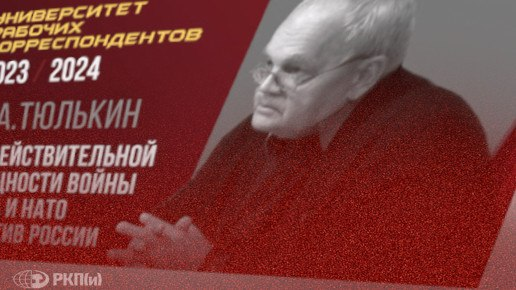
As we can see, our social-chauvinists began calling the competitors of Russian capital fascists when it was not yet mainstream.
In particular, back in 2014, a letter from the Central Committee of the Russian Communist Party was published, which defended the theory of fascism for export and polemicized against with its opponents. Recently, the RCRP has reaffirmed its commitment to the theory of “fascism for export.” The definition given in their first article —
“Fascism for export is an undisguised, terrorist imperialist policy of violence and bloody solution of issues of ensuring the interests of world imperialism, the core of which is financial capital, that ignores the laws and norms of international law.”
— literally coincides with M. V. Popov’s definition and is derived from the foreign policy of a number of imperialist Western states, using the mechanical application of Dimitrov’s well—known formula to this foreign policy: “Fascism is an open terrorist dictatorship of the most reactionary, most chauvinistic, most imperialist elements of financial capital, a special form of class rule of the bourgeoisie.”
But this formula refers to domestic politics, which is evident, among other things, from the phrase about “a special form of class rule of the bourgeoisie.” Of course, domestic and foreign policy are interrelated, but fascism is essentially a phenomenon of domestic politics, the class struggle of the bourgeoisie against the proletariat. Fascism in power is a special form of the political superstructure of bourgeois society, different from another form — bourgeois democracy. The bourgeoisie resorts to fascism to maintain its rule when the bourgeois-democratic methods of retaining power by capital are no longer sufficient. This usually happens when the class struggle of the proletariat intensifies, when there is a real threat of a proletarian revolution.
Why is the theory of “fascism for export” untenable and harmful?
Firstly, the very justification of “fascism for export” by analogy is perplexing, when the categories of domestic policy are mechanically transferred to completely different phenomena of foreign policy. They say that if ordinary fascism is when bourgeois democracy is replaced by open violence and suppression of the proletariat inside the country, then violation of international law and violence in the international arena is “fascism for export.” But fascism is one of the forms of the bourgeois state, i.e. the form of political relations between classes within one country, the form of the rule of the bourgeoisie over the proletariat, and to apply it to relations between countries, especially between capitalist countries, i.e. between different groups of the bourgeoisie, each of which has its own state, is just a vivid example of a violation of all the rules of the scientific approach to the issue.
Secondly, an aggressive foreign policy is inherent in any bourgeois state, even the most democratic one. Moreover, in general, the “bad” Western imperialists are not doing anything special in foreign policy right now. Compared to what was done, for example, by the British or French colonialists 150 years ago, during the heyday of bourgeois democracy, modern imperialists may seem quite kind.
Take, for example, the same aggression against Libya described in the RCRP article. All decent people were deeply outraged by this crime of imperialism. Nevertheless, this is an ordinary war of conquest. Moreover, what would the capitalists have done two hundred years ago, or the real fascists? They would simply invade Libya with their troops and kill everyone. And then the imperialists of the United States, Britain and France organized an uprising against the Libyan government, forced Gaddafi by diplomatic pressure to abandon the possibility of quickly suppressing this rebellion, armed and trained the rebels and had them act in the interests of NATO imperialism . When the need arose for direct military support of the rebels by NATO aircraft, the Western imperialists received the consent of the UN Security Council to impose a “no-fly zone” (including, without using the right of veto, gave the green light to the aggressors of Russia and China). And then they did not occupy Libya and did not include it “into the Reich,” but created a puppet government there. That is, instead of direct, crude and undisguised aggression, the Western imperialists spent quite a lot of effort to somehow formalize their actions legally, from the point of view of international law, and present them not as a war of conquest, but as “support for the liberation uprising of the Libyan people against the dictator.”
That is, even if we proceed from the silly analogy between domestic and foreign policy underlying the theory of “fascism for export,” they acted more in the spirit of bourgeois democracy (when class violence on the part of capital is more disguised) than fascism. I must say, by the way, that the Russian bourgeoisie, from the point of view of the legal and democratic formalization of its special operation, worked much less subtly.
In general, one cannot draw a conclusion about t fascism or any fascist tendencies based on the aggressive foreign policy of the United States and other Western imperialists. Since an aggressive foreign policy, violation of “norms of international law”, etc. are inherent in imperialism as such and are not a distinctive feature of fascism.
The persistent search for “fascism” in other imperialist countries can only lead to excessive demonization of American and Western imperialism in general and to the conclusion that one should always support “one’s own” imperialists and their Chinese, Iranian, etc. allies against Western ones.
Thirdly, the theory of fascism for export can only create theoretical confusion, but in practice it can lead to the negative consequences that critics point out and that the authors of the aforementioned article themselves honestly mentioned.:
“The question deserves the most careful consideration: are we dividing the imperialist countries into “bad” (“fascist”, “neo-fascist”) and “good”? In addition, the call for the formation of “anti-fascist fronts”, allegedly in a classless direction with all “progressive and honest people,” according to a number of comrades, is very similar to the anti-American propaganda that can be heard from many opportunists, ranging from adherents of Chavez to pro-Putin agitators in Russia. Isn’t such a position dangerous for the communist movement and the working class because it creates confusion when forming a line of supposedly “healing” imperialism by dissociating itself from “fascist forces”? Isn’t there a call to unite with other forces that have nothing to do with the cause of socialism? In fact, in the name of the fight against fascism, does there not arise a risk of strengthening forces that support cooperation with opportunism, social democracy, and parts of the bourgeois class? Doesn’t this open the way for choosing the right imperialist? That is, in the event of a regional or total military conflict, will the communist movement have to support specific imperialist powers in the name of the fact that others are “fascist”?”
The article calls these concerns unfounded. But at the same time, examples are given when the USSR entered into an alliance with the imperialists of the USA and Britain against German fascism. From this analogy alone, it can be seen that the critics’ fears are not unfounded. It is one thing when there is a proletarian, socialist state and it uses the contradictions between the capitalists for its own preservation. It is quite another thing when there is no socialist state in Russia, and Russian communists may be asked to support the bourgeois Russian state. Actually, the events of 2022 have shown the full validity of the fears of critics of the export theory.
Fourthly, attributing such features of foreign policy as aggressive wars, violation of international law, etc., which are completely natural for imperialism, for capitalism in general, and for any exploitative state in general, whether slave—owning, feudal, or capitalist, attributing them to some kind of “fascism for export” is, in fact, justification and apologia of capitalism. Since this leads to the conclusion that ordinary, “non-fascist” capitalism can and even should exist without violence against other peoples, without wars and seizures, without organizing coups in other countries, etc. Which contradicts the very essence of capitalism.
Finally, modern imperialism is indeed characterized by fascist tendencies, but there is no fundamental difference between the different imperialist states in this matter. In many ways, today’s Russia is even ahead of its Western competitors.
In general, the theory of “fascism for export” could only lead to the theoretical and practical disorientation of the Communists and their supporters. And to support his bourgeois government. Which is exactly what the RCRP has come to.
Categories: Anti-Fascism, International, Russia
 International Conference of Marxist Leninist Parties and Organizations: “Let us go onto the streets on May Day with a louder voice against exploitation and imperialist aggression!”
  The Red Phoenix