
Arbeit Zukunft | Apr. 3, 2026 | Translated for the Red Phoenix by Maurice B.–

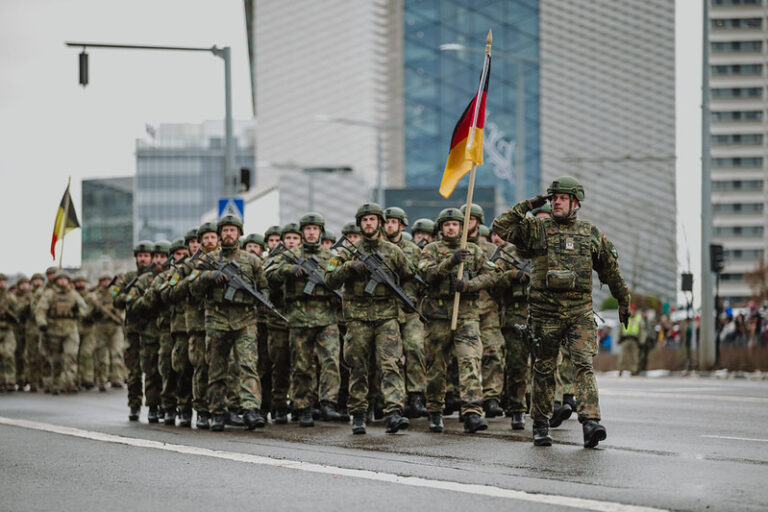
With a spending target of 5 percent of gross domestic product (GDP) for the military, EU member states (with the exception of Spain) are radically increasing their defense budgets. In 2025, military expenditures of the EU member states amounted to 392 billion euros. The EU Commission is now expecting defense spending of approximately 900 billion Euros for the implementation of the 5% target.
What does the EU want?
There are, of course, reasons for this steady increase in military spending. It is striking that this military buildup coincided with the EU’s expansion following the dissolution of the Warsaw Pact, at Russia’s expense. There was thus a massive redistribution of spheres of influence in Europe and a significant increase in the power of the EU—and, by extension, of German imperialism. The war in Ukraine is therefore also an expression of this redistribution, as imperialist Russia seeks to reverse part of this redistribution against the imperialist EU and expand its sphere of influence once again. It is thus clear that the EU and Germany are by no means innocent bystanders in this, but have mercilessly exploited the weakness of their imperialist rival.
In this context, the EU assumes the role of balancing the differing interests of the imperialist actors within the EU and the various capital groups, in an attempt to facilitate action that is as unified as possible. However, this is very difficult, as is currently evident, for example, in Hungary’s veto of further war credits for Ukraine.The collapse of the Mercosur agreement, which was supposed to create the largest free-trade zone in the world in favor of large monopolies and guarantee access to important raw materials, is also an expression of the struggle between the imperialist powers within the EU. This strained unity is equally evident in the failure of plans for a joint fighter aircraft (FCAS) due to competition between German and French defense companies. It is clear that the two strongest imperialist powers in Europe, Germany and France, are competing for leadership. In addition, other imperialist powers are also working to thwart the EU’s rise to the status of a world power. It is obvious that the U.S. is working intensively to keep its rival in check and is more or less openly supporting corresponding forces such as the Rassemblement National in France or the AfD in Germany. Imperialist Russia, too, supports forces such as Orbán in Hungary.
Although it is becoming increasingly difficult to reconcile the various powers in the EU in light of the growing rivalry among the major powers – the U.S., Russia, and China – the EU continues to work toward this goal. As early as 2003, it developed a “European Security Strategy” and openly set the goal of transforming the EU into a global player. In the further development of this strategy in 2016, the call to build “cutting-edge military capabilities” became even more explicit. In 2022, the “return of power politics” was posited, and the United States was identified as a competitor alongside Russia and China.
In 2025, the “White Paper on European Defense” was published. The magazine “Wehrtechnik” saw this as a “paradigm shift” of the EU “from a junior partner in security policy to a strategic actor.” The Süddeutsche Zeitung (March 15, 2025) called the White Paper “a kind of divorce petition for the American-European marriage.” “Page after page, the document lists initiatives through which the European Commission aims to strengthen Europe’s armies and build up and expand the continent’s defense industry. And the strategic context in which all this is to take place is not merely the growing threat from Russia. Rather, it is fundamentally the fact that Europe must become capable of defending itself—that is, independent—because it can no longer rely one hundred percent on support from the U.S. in the event of a crisis.”
The draft White Paper (p. 4) states: “The only way to overcome this dependence is to develop the necessary capabilities through joint European capability projects, especially now that the United States is rethinking its approach and may consider restricting or even halting the use of enablers [strategic core capabilities].”
Although Article 41(2) of the EU Treaty explicitly prohibits military spending, the EU circumvents this by launching defense programs under the guise of “industrial support.” Under cryptic names like EVF, EDIPRA, ASAP, EDIP, etc.—which mean something only to insiders—it has created arms promotion programs worth many billions of euros. These aim to create a strong and unified European arms industry. To receive funding, multiple corporations from several EU countries are required to collaborate. This promotes concentration and the formation of monopolies. Thus, economic means are being used to gradually achieve—through the formation of large European defense monopolies—what is currently not succeeding very well in the political sphere. A powerful imperialist EU is to be created in the interests of the major monopolies. One of the goals is “to make at least 50% of all defense investments within the EU by 2030 and 60% by 2035.” (EU Regulation on EDIRPA, Oct. 18, 2023) The aim, therefore, is to reduce arms purchases from the U.S. and build up a powerful domestic arms industry. With the ASAP program, the goal is to “put our industry into war economy mode now.” (euractiv.com, May 3, 2023) It is revealing that the talk here is no longer of “defense” but openly of war. Equally revealing is how methodically this is being carried out. This is not “self-defense” against an aggressive Russia, but rather an effort to act as a major power itself and to prepare military force, as Clausewitz, the Prussian major general, once said, “as a continuation of politics by other means.”
Germany’s role
As already noted, Germany leads the EU when it comes to military buildup. In his first policy statement, Chancellor Friedrich Merz announced plans to expand the Bundeswehr into “Europe’s strongest conventional army.” Defense Minister Pistorius (SPD) backed Merz: “Our security must not be jeopardized by budgetary constraints.” Therefore, following a constitutional amendment, unlimited debt may be incurred for armaments and war.
And for some time now, there has also been talk of “European nuclear weapons.” Since Germany has committed itself to renouncing nuclear weapons, German imperialism finds itself in a bind. It would have to violate treaties binding under international law to acquire its own nuclear weapons. However, “European nuclear weapons” would give it the chance to gain access to them. The EU is the vehicle for circumventing the treaties. There is already a “high-level nuclear steering group in which Germany is also involved…” (Deutschlandfunk, March 11, 2026).
Conclusions
The government’s war course is extremely dangerous. The more Germany seeks to establish itself as the ruler of Europe, the more other imperialist powers will work against it. The contradictions are intensifying. The danger that the struggle for supremacy will be settled by force through war is growing.
What war means for the people and the working class can currently be clearly seen in the Middle East. Since Germany lies at the heart of Europe, it is of central importance in the struggle for the redivision of the world and would thus always be a central theater of conflict in a war. Decisive battles would take place here. What that means was clearly evident in WWII: large-scale destruction. With modern weapons or even nuclear weapons, the destruction would be many times greater. It is therefore vitally important for the working class and the people to fight against this course toward war.
Categories: Anti-War, Germany, International, U.S. News
 Arbeit Zukunft (Germany): U.S. National “Security” Strategy a mask for imperialist hegemony
  Deleted Daily Mail Online Article: “US Backed Plan for Chemical Weapon Attack in Syria to Be Blamed on Assad”
  On “Islamofascism” & Islamophobia
  Who Was Richard Holbrooke?
  The Red Phoenix