
John M. | Red Phoenix correspondent | Colorado
The Trump administration’s recent decision to abandon plans to reconsider the Biden-era ban on chrysotile asbestos, the last form of this deadly mineral still used in the United States, is a rare victory for public health and a lifeline for working-class communities. Initially revealed in court documents in June 2025, the administration’s flirtation with delaying or weakening the ban sparked outrage, threatening to revive a known carcinogen linked to over 12,000 deaths annually in the U.S. alone. By backing down, the U.S. has dodged a bullet, averting a catastrophic rollback that would have prioritized corporate greed over human lives. For communities like Libby, Montana, devastated by asbestos’ toxic legacy, this decision is a critical step toward ensuring no more workers or families are sacrificed on the altar of profit.
Asbestos, a naturally occurring fibrous mineral prized for its heat resistance and durability, was once hailed as a “miracle material.” It was widely used in construction, insulation, roofing, and automotive parts, embedding itself in homes, schools, and workplaces across America. But by the 1960s, scientific evidence began to expose its dark side: asbestos exposure causes lung cancer, mesothelioma, ovarian cancer, laryngeal cancer, and asbestosis, a chronic disease that leaves the lungs covered in scar tissue. Even minimal exposure, sometimes as little as a single day, can trigger these diseases, which often lie dormant for decades before claiming lives.
Had the Trump administration followed through on its initial plan, led by EPA Administrator Lee Zeldin, to delay the ban for at least 30 months, the consequences would have been dire. Workers in industries like chlorine manufacturing, where chrysotile asbestos remains in use, would have faced prolonged exposure to an “unreasonable risk” of illness, as confirmed by the EPA’s own data. Reversing course on this dangerous proposal is a triumph for science and advocacy, sparing countless lives from the slow, painful demise asbestos inflicts.
To understand the human cost of asbestos, look no further than Libby, Montana, a small working-class town that once dominated the global vermiculite market. Vermiculite, a mineral often contaminated with asbestos, was mined in Libby by the Zonolite Company and later W.R. Grace & Company from the 1920s until 1990. At its peak, the mine produced 80% of the world’s vermiculite, used in insulation, gardening, and construction. But the mine’s success came at a catastrophic price. W.R. Grace knew about the asbestos contamination as early as the 1960s but failed to warn workers or the community. Miners came home covered in white, asbestos-laden dust, unknowingly spreading it to their families. The mine’s tailings were used as fill for driveways, playgrounds, and gardens, blanketing Libby in a toxic haze. Residents breathed it in for decades, unaware of the invisible fibers lodging in their lungs.
The consequences were staggering. In a town of fewer than 3,000 people, over 400 have died from asbestos-related illnesses, with thousands more diagnosed. Diseases like mesothelioma and asbestosis have left survivors struggling to breathe. The latency period of these diseases, often 20 to 50 years, means new cases continue to emerge, even though the mine closed in 1990. In 2009, the EPA declared Libby a Public Health Emergency, launching a massive cleanup effort that has removed over one million cubic yards of contaminated soil. Yet the town’s scars remain, both physical and economic, as the once-thriving community grapples with its toxic legacy.
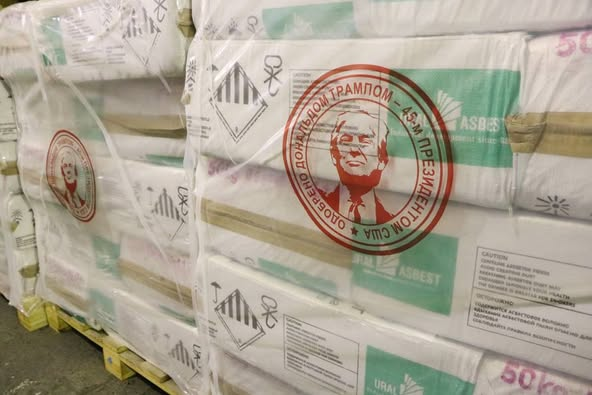
President Donald Trump’s support for asbestos is well-documented and deeply troubling. In his 1997 book, The Art of the Comeback, he called asbestos “100% safe, once applied” and dismissed its health risks as a “mob-led” conspiracy to profit from removal contracts. This claim, echoed in his 2005 congressional testimony where he credited asbestos with fireproofing capabilities, ignores overwhelming scientific consensus. Trump’s stance has even earned him a perverse endorsement from Uralasbest, a Russian asbestos producer that in 2018 stamped his face on its products with the words “Approved by Donald Trump, 45th President of the United States.” Russia, a major asbestos supplier to the U.S., stands to gain significantly if the ban is lifted.
During his first term, Trump’s EPA, under Scott Pruitt, refused to ban asbestos outright, opting instead for a “Significant New Use Rule” (SNUR) that allowed case-by-case approvals for new applications. This framework, criticized as a loophole for industry, ignored legacy asbestos in homes and schools, where it poses the greatest risk to workers and residents. The current reconsideration, spearheaded by EPA Deputy Assistant Administrator Lynn Ann Dekleva, a former American Chemistry Council lobbyist, signals a continuation of this pro-industry agenda, prioritizing corporate profits over public health. The potential rollback of the asbestos ban is a stark example of how working class communities withstand the worst of capitalist deregulation. In Libby, miners and their families were expendable to W.R. Grace, whose profits soared while the town choked on dust. Today, workers in industries like chlorine manufacturing, where chrysotile asbestos is still used, face similar risks. The EPA’s own data shows that even with current protocols, workers in these plants face an “unreasonable risk” of illness. Yet industry groups like the American Chemistry Council argue that existing workplace protections are sufficient, echoing arguments that overturned the EPA’s 1989 ban attempt.
Economic interests often take precedence over worker welfare. Asbestos-related diseases mainly impact miners, construction workers, firefighters, and factory employees exposed on the job. Corporate executives seek deregulation to reduce costs and increase profits, insulated from these dangers. The Trump administration’s deregulatory actions, such as weakening PFAS chemical and greenhouse gas rules, reflect a similar focus on economic competitiveness at the expense of worker health.
Public health advocates warn that delaying the asbestos ban will lead to avoidable diseases and deaths. Linda Reinstein, president and co-founder of the Asbestos Disease Awareness Organization, states that even minimal exposure can be fatal, as evidenced by Libby’s experience. The science confirms there is no safe level of asbestos exposure. However, the Trump administration’s reconsideration, influenced by industry pressure and deregulation, risks overlooking this fact.
Libby, Montana, highlights the need for strong protections against hazardous substances. Policies must prioritize health over profit. Communities, workers, and advocates should urge policymakers to uphold the asbestos ban, support organizations raising awareness about its dangers, and promote accountability for industries using harmful materials. By uniting, we can ensure worker safety and public health are prioritized, preventing tragedies like Libby’s. United and organized, we can create a system that values lives over corporate interests, so we can all breathe a little easier.
Categories: Environment, Health Care, U.S. News
 Cancer, capitalism, and corporate farms in Iowa
  How Billionaire ‘Philanthropy’ Is Fueling Inequality and Helping To Destroy the Country
  ‘Crack baby’ study ends with unexpected but clear result
  Phoenix Mayor Attempts To Live On A Food Stamp Budget: ‘I’m Tired, And It’s Hard To Focus’
  The Red Phoenix