
Piattaforma Comunista (Communist Platform, Italy) | Translated from Italian by Red Phoenix correspondent Michael G.–
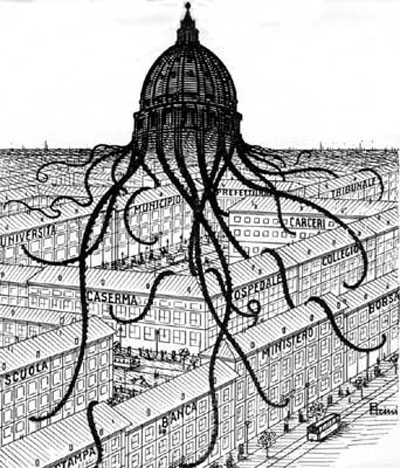
Editors’ note: The role of the Catholic Church has always been that of reaction, but this is especially pronounced in Italy, where the Church supported the Fascist Mussolini regime (along with the Franco regime in Spain). Even after Mussolini fell and the U.S. gained control of the Italian state, the Catholic Church, through the Christian Democratic Party, was used by the American imperialists as the main bulwark against the socialist revolution– which almost happened in Italy, but was crushed by both the influence of Soviet revisionism and American imperialism. Even today, the Church maintains a strong influence in “Catholic Trade Unions,” which are used to blind the people.
Pope Francis, born Jorge Mario Bergoglio, the absolute sovereign of the Vatican City State, who had always maintained a great ideological and diplomatic influence on the world, died on April 21, 2025, the day after Easter.
His passing has unleashed an unprecedented wave of hypocrisy and demagogy, along with attempts to impose five days of national mourning on the country. (So much for separation of Church and State!)
In an effort to resolve the crisis of an ungovernable Vatican and a scandal-ridden Catholic Church—plagued by corruption, sexual abuse, leaked documents, financial turmoil, and internal conflict—the previously obscure Jesuit was elected pope in March 2013, following the resignation of the deeply unpopular and ineffectual Benedict XVI.
With Pope Francis’ reign now over, what is the balance sheet of his twelve years as pontiff—from his first “Buonasera” (“good evening”) on the balcony, to his final meeting with J.D. Vance? He was elected to rescue the sinking ship of a reactionary institution taking on water from all sides, in a bid to regain some consensus or public support. At first, the ‘Bergoglio effect’ worked: his populist theology, unconventional gestures, strong communication skills, and groundbreaking positions—on migrants, on refusing to excommunicate divorced people and gay couples, on sexual abuse, and on the ecological crisis—resonated widely. He shook the self-referential nature of the Vatican hierarchy, projecting the image of a pope ‘close to the people’—and in doing so, triggered backlash from the most reactionary factions of the Church.
But in the long run?
Efforts to re-evangelize the geographical and social peripheries—the poor and marginalized, who are essential to the Church’s existence—have made little progress, especially in Europe. Dialogue with other religions, despite high-level meetings, has not produced meaningful results
Especially in the advanced capitalist countries, the religious orders are being slowly decimated by the lack of those choosing to enter religious professions, the continuous decrease of seminary students and priests (while the number of bishops has grown). The number of self-professed religious people is also declining along with the number of religious marriages and baptisms.
The issue of reproductive rights, especially abortion, has highlighted the insurmountable limits of Bergoglio’s so-called “progressivism.” There has been no reconciliation with modern science, and the school has become more reactionary and conservative. The so-called ‘heir of Francis of Assisi’ has remained substantially isolated on the international scene. In times of war his appeals for peace have had no results. The contradictions with Trump’s policy have seen him on the defensive.
Despite his prattle about “restoration” of the “true spirit” of the Church, and his myriad reforms, the Vatican’s budget remains as red as the blood of Christ, with a deficit of around 90 million euros.
The Catholic Church has remained divided internally too.
To those who want to see in Bergoglio a “socialist,” let us recall that this pope has denounced certain scourges of contemporary society, without ever questioning the capitalist system that produces them—a system the Vatican and the Church defend in the name of the sanctity of private property and bourgeois profit, blessed by all the priests.
Now, a Yankee cardinal has been elected pope by the conclave: Robert Prevost, now Leo XIV. He is a conservative Augustinian, chosen across the board as a pope of mediation between opposing clerical currents and organizations (fundamentalists, modernists, centrists) to save the apparent unity of the church and maintain the cohesion of the Catholic base, without which the deeply torn apparatus would weaken even more.
Because of his American origins, he will try to influence the Trump regime with less hostile policies while at the same time, ensuring the financing of the richest dioceses in the world, an indispensable financial lung for the Vatican.
The twenty years Pope Prevost spent working in Peru will help maintain support in South America, the Vatican’s strategic reserve (home to 27% of all Catholics), which is seeing one of the fastest-growing Protestant movements in the world. “Prevost has taken the name Leo XIV—an explicit nod to Pope Leo XIII, author of the encyclical Rerum Novarum, which addressed the conditions of the working class in an effort to steer trade unions toward the right. This choice signals an intention to preserve Catholicism’s influence over workers and unions, in opposition to the resurgence of the Marxist ‘’real movement which abolishes the present state of things,” now reemerging and gaining ground in many parts of the world as we move towards a new economic crisis.
Prevost’s election is the result of a political choice aimed at keeping the Church afloat—one that will not resolve the Catholic Church’s crisis. It cannot do so because this reactionary power is historically on the defensive and in decline after the blows dealt first by the French Revolution and then by the October Socialist Revolution. The church has not been able to recover even after the temporary defeat of socialism, because the economic conditions of its hegemony have been exhausted and it is continually subjected to the initiative of its adversaries. It can no longer be the dominant ideological force, but is a secondary force. It cannot innovate because this would result in further internal splits. It is therefore destined to lose ground and to undergo external secular influences. It will continue to prop up a terminally ill bourgeoisie, which needs it “just as a crutch supports an invalid” (Gramsci). Through concordats, it will keep securing privileges, recognition, and funding—paid for by the working class. It will pursue its own ideological and economic goals, interfering in political life without truly committing to the social principles it proclaims—principles that will never be implemented by the Catholic hierarchy or the bourgeoisie, who use Catholic trade unions and mass organizations to undermine the development of the proletariat’s antagonistic movement.
The future does not belong to Catholicism, but to proletarian socialism, which embodies universality and the complete liberation of humanity—as a necessity born from historical development.
It is therefore the task of the communists to carry forward the radical critique of Catholicism on the ideological and political level, to weaken and combat the nefarious influence of the church and of the alienating and narcotic religious ideology in the workers’ and popular movement, while preparing the next “assaults on heaven.”
The Communist Party of the proletariat, for which we fight, also serves this purpose: to raise the level of consciousness and culture of the proletariat, making it ideologically advanced and unified.
Categories: International, Italy
 Striking workers shut down 21 ports in solidarity with Palestine
  Piattaforma Comunista (Italy): Long live the resistance of the Venezuelan people!
  The Sumud Flotilla is attacked; general strike in Italy!
  Italy: Declaration of the Organization for the Communist Party of the Proletariat
  The Red Phoenix