
Twin Cities Tenants Union | Minneapolis, MN–

Today labor and tenant unions in Minneapolis and St. Paul announced a March 1 rent strike drive, calling on Minnesota Gov. Tim Walz to immediately declare an eviction moratorium and the state legislature to establish a $50 million rent relief fund.
Representing more than 25,900 workers, these five labor unions and the new cities-wide tenant union together vow to show an unprecedented expression of economic power to ensure action from the Governor.
Twin Cities Tenants, a cities-wide tenant union in Minneapolis and St. Paul, joins with SEIU Healthcare MN/IA (representing 9,000 workers who live and work in the Twin Cities), SEIU Local 26 (representing 8,000 workers in the Twin Cities), Unite HERE Local 17 (representing 6,000 workers), ATU 1005 (representing 2,300 workers), and CWA 7250 (representing 600 workers) to launch the strike drive.
Following decisions by their executive teams, these unions are actively organizing their membership towards the March 1 rent strike. Take Action Minnesota has committed 1,500 of their members, mostly parents and teachers, to take the strike pledge, and Unidos Minnesota is moving the pledge to its 8,000 members.
The unions and community groups are joined by Minneapolis City Council Members Jason Chavez (Ward 9), Aisha Chughtai (Ward 10), Aurin Chowdhury (Ward 12), and Robin Wonsley (Ward 2). The Councilmembers have fought for a statewide eviction moratorium, and they are all tenants who have now pledged to strike on March 1.
Just 10,000 tenants withholding rent in March alone would result in a $15 million economic disruption. This would more than double the “normal” levels of rental debt for landlords across the Twin Cities.
If authorized and launched, this would be the largest rent strike in the United States in the last 100 years, and the largest rent strike in Minnesota’s history.
The strike drive follows nearly three months of federal occupation, which has taken a painful economic toll on poor and working class tenants across the Twin Cities. Over 35,000 low-income Twin Cities households were already unable to afford the rent before the federal siege. Estimates show over $47 million in lost wages among people who have not been safe to go to work, and at least $15.7 million in additional rental assistance needed due to lost household income – leaving many of those households at imminent risk of eviction.
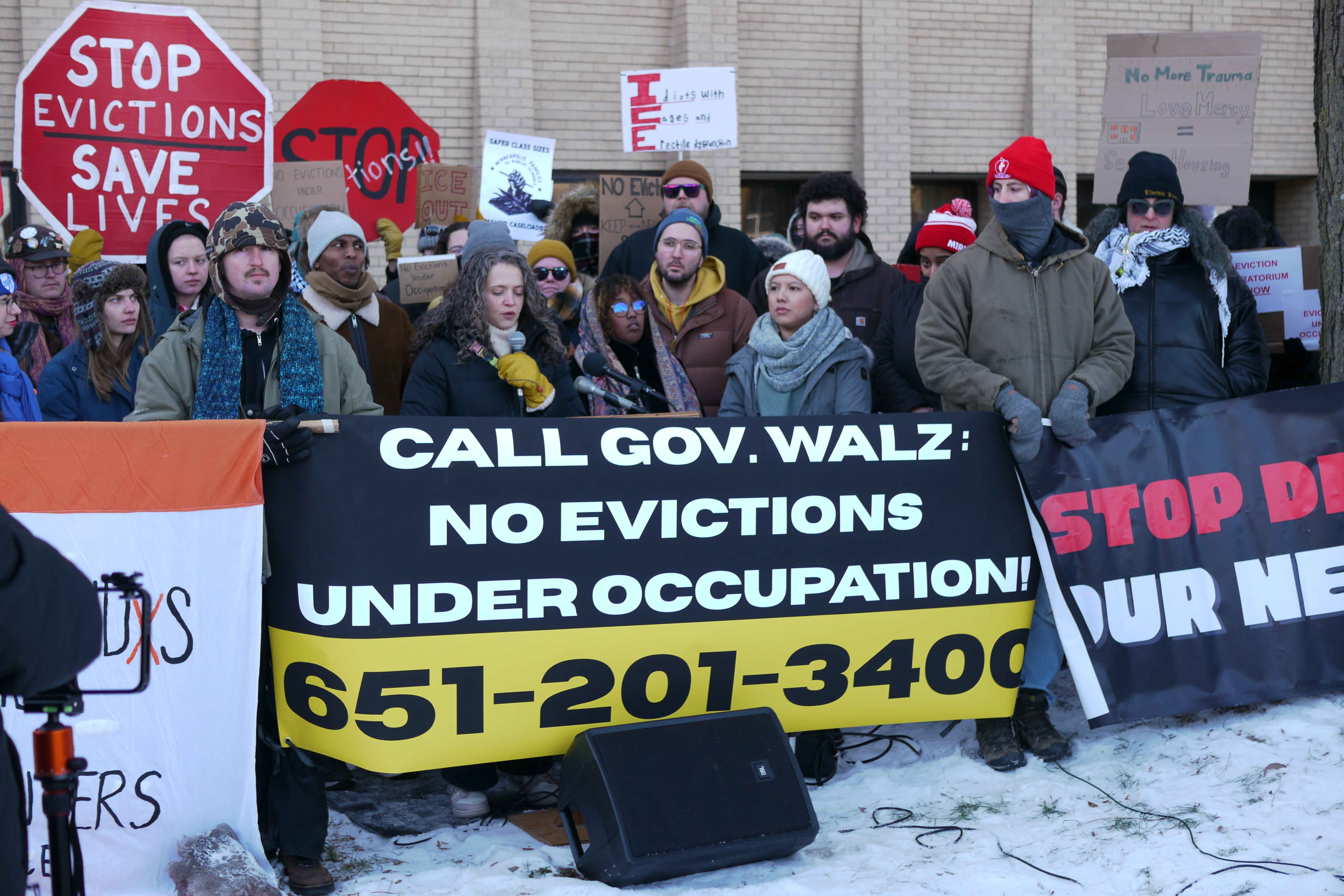
Despite monumental efforts by community members to distribute nearly $5 million in rent relief, evictions in the Twin Cities are already spiking. In January 2026, landlords across Minneapolis and St. Paul filed 1,311 evictions; this is up 12% from December 2025, and 26% over the January average in the past few years. The top evictors under occupation include large companies like Dominum, Aeon, Roers Companies, and The Related Companies. The list also includes landlords like Sherman Associates, who have opened up hotels to ICE.
Even as the federal government announces a “draw down” of Operation Metro Surge, the economic impact of the occupation will continue long after the ICE agents are gone. Because of mutual aid funds and local protections, like 30-day notice for filing in Minneapolis, tenants may have avoided court so far, but occupation evictions will be heard soon.
“In the last two months, I’ve been stuck in the house. I can’t work, so I can’t pay rent. All we want is freedom, to feel that we belong someplace, to work. Today I am pledging to rent strike on March 1 because I know that when we fight, we win,” said Anain, a member of Inquilinxs Unidxs por Justicia and Twin Cities Tenants. “Today, I’m more scared of what’s been happening than I am scared of the risk of going on strike. I am ready to withhold my rent, alongside my neighbors across the Twin Cities, until we win.”
“Tenants in Minnesota are in a crisis. The federal invasion forced many of our neighbors to stay home, and devastated our local economy,” said Minneapolis City Council Member Aisha Chughtai. “We need real solutions for the cliff of rental crisis we are facing on March 1st. I will be going on rent strike on March 1, and I call on my constituents to join me, until we can get a real solution from our state government for this crisis.”
“Our union has always understood that no matter what we win at the bargaining table, if we don’t join fights led by the community around things like keeping us safe and having an affordable place to live, we aren’t materially making lives better,” said Greg Nammacher, President of SEIU Local 26. “We know many of our members are like thousands of Minnesotans who have been facing immense challenges over the last few months because of the federal occupation, and now are facing impossible situations around paying their rent. We are telling our members about the strike drive and encouraging them to get involved if this is an issue that is important to them because we know that collective action is the only way to take on problems this large.”
“We absolutely need an eviction moratorium,” said Geof Paquette, Internal Organizing Director at Unite Here Local 17. “Our members were struggling to keep up with housing costs before ICE occupied our streets. It has now become an emergency as many of our members are behind in their rent. It’s well past time for some relief.”
“Take Action members have been deeply impacted by the presence of federal agents in Minnesota, including organizing robust mutual aid in school communities to ensure students and families could stay home and safe during the past two months,” said Amanda Otero, Co-Director of Take Action Minnesota. “Many of our neighbors are at risk of losing their housing due to this crisis and we are raising our voices to demand an eviction moratorium and rent relief. We are ready to talk to our members about a rent strike as a strategy to ensure our demands are met.”
“First, we stand in solidarity with workers in all sectors,” said David Stiggers, President of ATU 1005. “Public transit workers are tenants, too, who serve the communities we live in. We are often living paycheck to paycheck and sometimes only one small emergency away from falling short on rent. Unstable housing leads to stress which leads to poor work performance and that’s detrimental to safety and reliability, which impacts the entire community. The ATU represents many frontline public service workers, those driving, maintaining, and riding transit so we’ll continue to fight for justice and equity in housing policies.”
“The people of Minneapolis and St. Paul have shown the way, fighting a federal invasion and caring for their neighbors; their fight and their care continues in this historic rent strike,” said Tara Raghuveer, Director of the Tenant Union Federation. “Out of deep consideration and profound seriousness, and facing March 1, when the rent is due and so many still can’t pay, tenants and workers have decided that if they have no other choice but to strike. In taking this step, they join a storied tradition of struggle. The struggle can end whenever the Governor steps in to do what’s right.”
Twin Cities Tenants is a cities-wide tenant union, organizing across Minneapolis and St. Paul. This effort is led by Inquilinxs Unidxs por Justicia, South Minneapolis Tenant Union, property-level unions, and block groups across the Twin Cities. Twin Cities Tenants is supported by the Tenant Union Federation, a national union of tenant unions.
Categories: Housing, Immigration, U.S. News
 The Red Phoenix