
Evan R. | Red Phoenix correspondent | Oregon–
According to Oglala Lakota president Frank Star Comes Out, four Lakota Sioux people were abducted by ICE agents in Minneapolis last month. According to the tribe, one of its citizens was released while the others are reportedly being held at a federal facility in Fort Snelling, the same place where 38 Dakota Sioux men were hanged in the largest single-day mass execution in U.S. history in Dec. 1862.
As part of “Operation Metro Surge,” ICE has launched massive raids against the indigenous community in Minneapolis, and has been trying to force their way into the Little Earth Housing project, the first indigenous community housing project in the city. As of Feb. 2026, these fascist thugs have been successfully turned away by determined resistance from local activists.
During the resulting protests, another Lakota person was arrested, along with a 23 year old Dakota Sioux man named William Lafromboise.
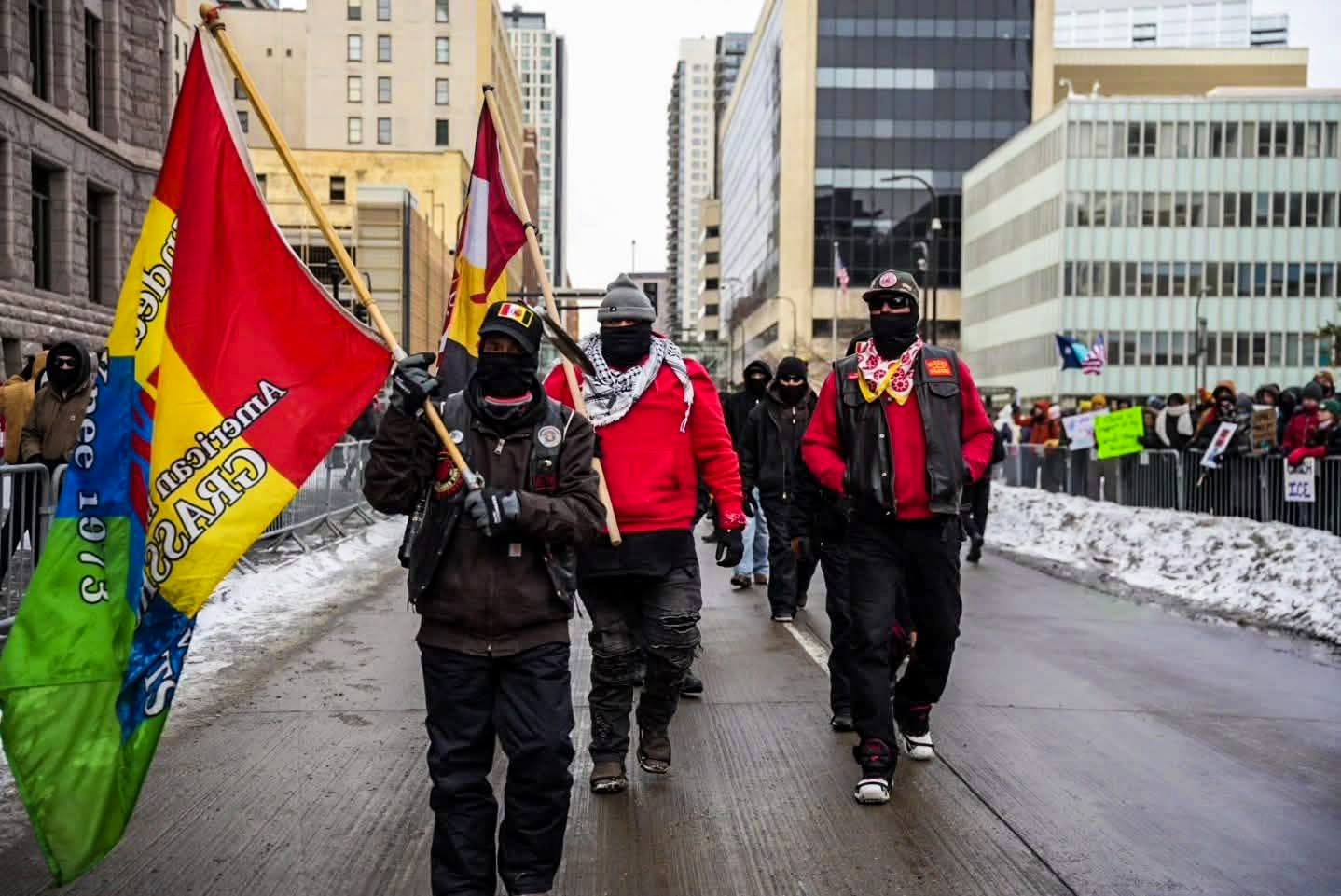
It is not surprising to see an organization led by Kristi Noem targeting indigenous people, her record as a congresswoman and governor of South Dakota is fraught with racism. This represents only the latest escalation in her long war against indigenous people and the Lakota Sioux in particular. Of course, Noem was not the first of the American bourgeoisie to target and repress the Indigenous peoples of this country; the United States government, as a capitalist dictatorship, has been waging a war of extermination on the Lakota for over 150 years.
The Lakota Sioux are an indigenous people who once ranged the northern Great Plains region of the future United States, living a semi-nomadic existence which was sustained mostly through large scale bison hunting.The Lakota are one of the groups that make up the great Sioux nation, and the majority of South Dakota’s substantial Indigenous population. The long struggle of the Sioux and their continued resistance to genocide has brought them into routine conflict with both state and federal forces.
In 1868, the Lakota were promised a substantial tract of land stretching from present day Montana and North Dakota to Nebraska, and encompassing the entire western half of South Dakota, which contained the sacred land known as He Sapa or the Black Hills.
This prospective Lakota autonomy was short-lived. In 1874, the discovery of gold in western South Dakota led to a “gold rush,” at which time thousands of illegal settlers invaded the heart of He Sapa, greatly antagonizing the Lakota. By 1876, the US Army arrived and the situation escalated into all-out war. Although the Lakota resisted heroically they were eventually defeated and forced to relocate to reservations which have been diminished over time via court actions to now encompass a few counties.
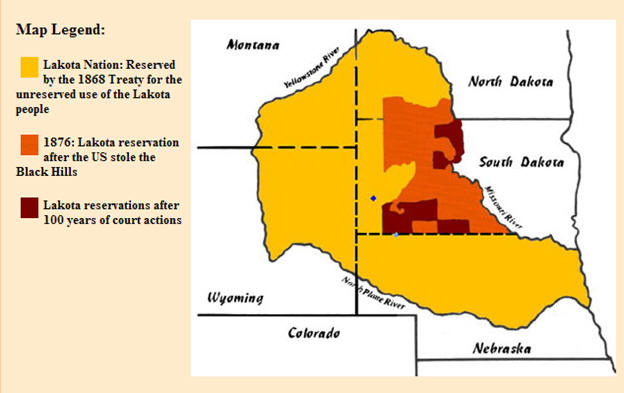
The theft of the He Sapa was so egregious that the Supreme Court ruled in favor of the Lakota in 1980, and ordered the government to pay them over 150 million dollars in compensation, a fraction of the land’s true value. The Lakota people have rejected this settlement, stating repeatedly that He Sapa is not for sale and demanding the return of the lands promised to them in the Fort Laramie Treaty.
Today, the Lakota are mostly confined to five reservations in western South Dakota, Pine Ridge, Rosebud, Cheyenne River, Lower Brule and Standing Rock. Significant populations of Lakota people have left the reservations and live in cities like Rapid City, SD, where they face systemic racism, segregation, and discrimination.
The conditions facing the Lakota people on South Dakota’s reservations are nothing short of genocidal. The conditions of the reservations have come about after over a century of intentional neglect by both state and federal authorities, designed to exterminate the people over time.
Natasha Cuny (left), her boyfriend, Raymond Eagle Hawk (center), and their daughter, Kimimila Eagle Hawk (right), stand outside the trailer of Raymond’s mother in Wounded Knee, South Dakota. Source: capjournal.com
Life expectancy for the Lakota is 48 for men and 52 for women, the second-lowest in the western hemisphere behind only Haiti.
The infant mortality rate is 300% higher than the US average, and many who do survive take their own lives with a teenage suicide rate 150% higher than average.
80% of Lakota people are affected by alcoholism, and drug abuse is increasing on the reservations. Indigenous communities have the highest meth addiction rates in the nation, with a 492% higher overdose rate than the rest of the nation. Diseases like tuberculosis, diabetes and cancer are at epidemic levels, the rate of cancer is 500% that of the US average. 50% of adults over the age of 40 have diabetes.
Health problems bear a disproportionate burden on the reservations as there is an acute shortage of both hospitals and trained doctors.
These health issues are exacerbated further by the poor quality of food on the reservations, all of which are considered “food deserts”. The Lakota live mostly on government commodities, which are poor quality and unhealthy food designed to kill the people slowly. Tap water is contaminated with radioactive uranium and arsenic, rendering it toxic and unsafe to drink.
The reservations are also stricken with extreme poverty, 97% of residents live below the poverty line and 88% are unemployed. Housing is overcrowded and inadequate. This means that every year, dozens of people die from the bitter cold of South Dakota winters. Over 40% of homes are infested with potentially fatal black molds, and 60% lack water, electricity, adequate insulation, and sewage systems. As many families cannot afford propane for cooking, chronic malnutrition stalks the reservations, especially affecting children and the elderly.
Even the land itself is poisoned. The Pine Ridge reservation was used as a military gunnery range for decades, contaminating the land and water and rendering it mostly infertile. Climate change has hit the reservations especially hard, with conditions of drought setting in for years at a time. Owing to their extreme poverty, most Lakota people do not have the money to buy the tools and supplies necessary to cultivate their own land, meaning it is rented out to non-indigenous farmers for pennies on the dollar. 94% of irrigated land in South Dakota reservations is cultivated by white farmers.
The Lakota culture has been ruthlessly suppressed by government and religious authorities. Only 14% of Lakota people can speak their own language, and the average age of a Lakota speaker is 65. The language is considered critically endangered and has lost over 4000 speakers in 10 years. Sioux history can no longer be taught in South Dakota schools, in large part thanks to Kristi Noem’s racist and white supremacist policies to crack down on so-called “critical race theory” and her creation of a “patriotic education” curriculum.
The school system on the reservations has collapsed from complete neglect. The dropout rate is over 70%, with only 28.7% of the Native population on the reservation holding a high school diploma or equivalent, and 10.7% possessing a bachelor’s degree or higher.
Women suffer a disproportionate burden on the reservations. Thousands of Lakota children have been stolen from their families and placed in foster care, unless their biological parents can prove in court that they are fit to raise children. Living in extreme poverty and with little access to lawyers, this in practice results in the permanent theft of children and breaking up of families. Far from ancient history, this is still common in South Dakota. Domestic violence is rampant, with more than 80% of women reporting having been victims of violence in their lives. One in three is a victim of rape, and indigenous women are murdered at ten times the rate of the national average. Many women are victims of human trafficking, the discovery of oil in North Dakota led to an explosion in sexual violence and human trafficking in the so-called “man camps” built for oil workers. Justice is rare for these crimes. According to Amnesty International many perpetrators get away due to “chronic under-resourcing of law enforcement and health services, confusion over jurisdiction, erosion of tribal authority, discrimination in law and practice.”
Noem has accelerated most of these problems during her time as Governor of South Dakota. Her racism towards the Sioux people is so extreme that she has been banned from all the reservations in the state.
Her policies have re-ignited a growing wave of militancy on the reservations and among the indigenous people of South Dakota. Organized protest movements have emerged in the state, with groups led by the Lakota taking the forefront. This has led Noem to implement draconian “riot boosting” laws, which impose heavy penalties on any dissent.
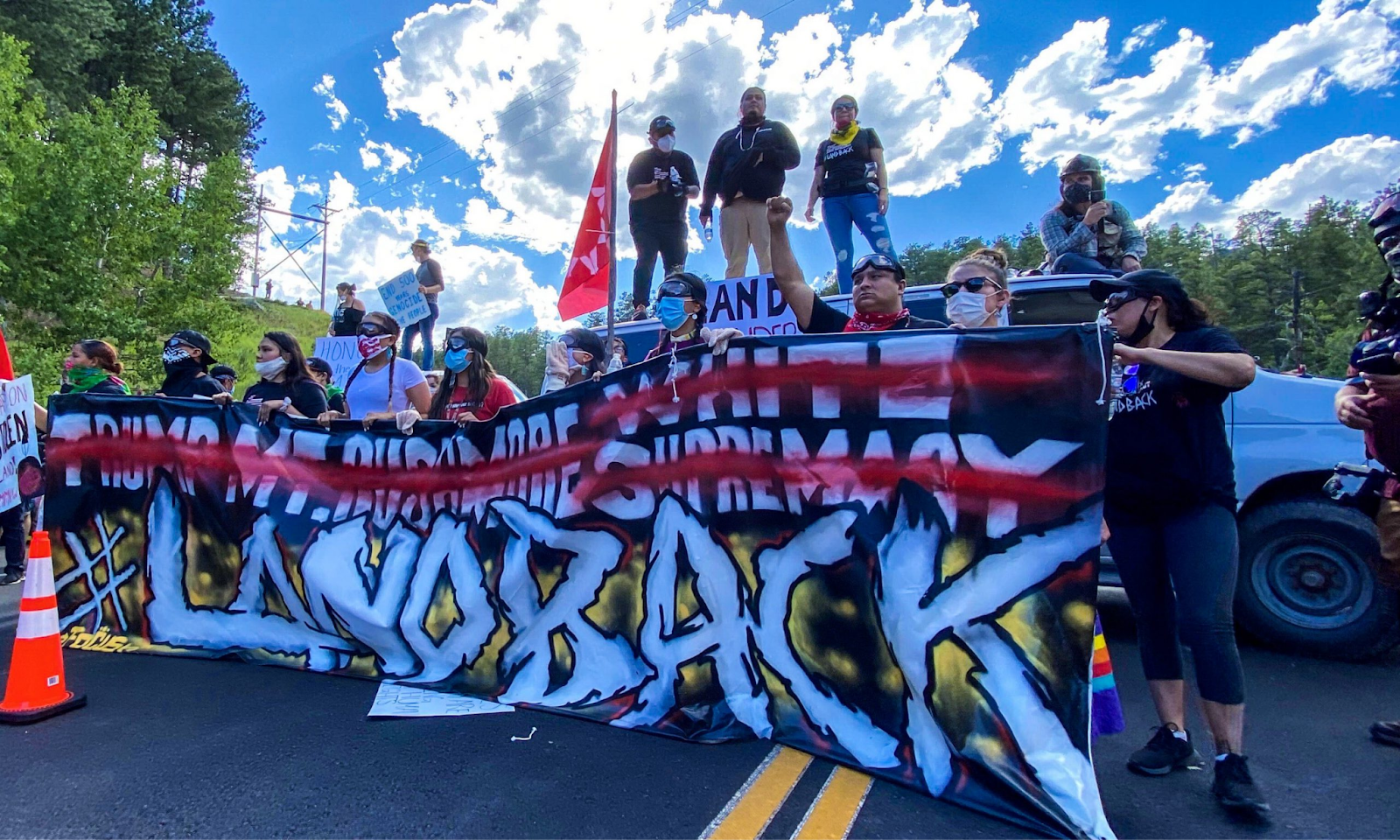
The strength of this resistance has been forged in the fire of 150 years of struggle and steeled from years of opposing the Dakota Access Pipeline on the Standing Rock reservation, which straddles the border of North and South Dakota. The government’s ferocious repression of protests on Standing Rock backfired and made the movement stronger and more militant.
As the tide begins to rise for the Lakota, they are finding themselves inside a re-invigorated Indigenous movement. A new wave of Indigenous activists have been building strength all across the nation and are now ready and able to offer real, tangible resistance against the state’s terror.
Indigenous activists have responded with mass mobilizations against ICE raids in Minneapolis, rising together with their community to resist the occupation of American cities by armed thugs. They have formed community patrols and mutual aid networks to resist ICE’s aggression and save their neighbors and relatives from deportation. Far from the narrative of paid agitators that is foisted by the Trump regime, the Indigenous communities fight with few resources but their own courage and solidarity with all working people of the United States resisting the xenophobic, racist and fascistic bourgeoisie that is our common enemy as the toiling masses of the nation.
Indigenous actions against ICE are part of a growing trend of increasingly militant action from all progressive and democratic sectors of society against the white supremacist goons terrorizing our communities. Workers are unifying across racial, ethnic, and national lines to oppose the state’s terror and fight back against the regime’s mass deportations.
The government fears this sort of organizing more than anything, and will stop at nothing to smother this movement in its cradle or sow division in its ranks.
We cannot allow that to happen.
It is our duty as Marxist-Leninists to imbue the working class with the highest level of organization and class consciousness and further temper both their will and their ability to resist and to fight against the class enemy.
We must keep up the pressure towards a goal not just of moderate reforms, but of the complete abolition of ICE and prosecution of all its agents and officials.
To achieve this, we must build the broadest possible coalition of progressive, antifascist elements, unified together towards a common goal and with a common understanding that the enemy is bigger than just ICE; it is the entire capitalist-imperialist system that sustains and guides its despicable conduct. Make no mistake comrades, ICE has continued to exist through two decades of bipartisan support.
Our elected leaders have neither the will nor the class interest to protect us.
We must protect ourselves, the working class, and work together to resist bourgeois state terror in all its manifestations. The answer to capitalist state terror is not wild rioting or decentralized militancy, but organized and properly planned and well-timed mass self-defense and unyielding resistance.
The state terror of the capitalist class cannot succeed if a front of antifascist resistance is organized and prepared, composed of all progressive and anticapitalist forces, to stand up in defense of our neighborhoods and our very lives.
Minneapolis has shown us what is possible. Now it’s up to us all, as a class, to push the class struggle forward further still, to heighten the class contradictions, and find the determination and will-power to bring the labor and communist movements to final victory!
Categories: Discrimination, History, Immigration, Racism, U.S. News, United States History
 Celebrate International Workers’ Day 2013!
  Michelle Bachmann, Slavery & Dog Whistle Politics
  Briefly on “Reverse-Racism”
  The Red Phoenix