
Maurice B. | Red Phoenix correspondent | New York–

There’s them on top and them below; push up, or push down. Who’s got more push? That’s all that counts.
– Sean Connery as Jack Kehoe
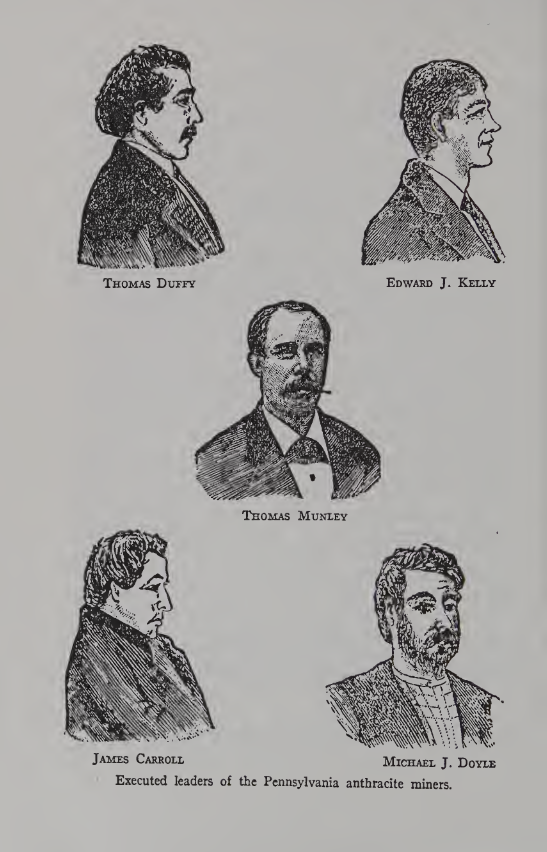
June 21, 2025 marked 148 years to the day since ten miners were hanged to death in Pottsville, Schuylkill County, and in Mauch Chunk, Carbon County, Pennsylvania. By 1878, nineteen miners in total would be executed for alleged crimes pertaining to their supposed involvement in a “secret society” of working-class Irishmen dubbed the “Molly Maguires.”
There is no credible evidence to support accusations of the existence of such an organization. Rather, these “Maguires” were members in an Irish nationalist organization called the Ancient Order of Hibernians (A.O.H.), whose leadership amongst the anthracite mines was militant, well-recognized, and much respected amongst other miners. These organizers were deemed terrorists, part of a clandestine group within the A.O.H. dedicated to committing murder, assault, and other acts of terror. This supposed group was called the “Molly Maguires” by the coal operators and capitalists:
…The execution of the Mollies was the culmination of a class struggle in which the ruling class as victor exterminated its most virulent enemies regardless of the fact whether this individual or that was the actual participant in the killing for which he was convicted. The killings themselves – of which there were more victims among the workers than among the mine owners’ entourage – were part and parcel of the fierce class struggle in progress. The operators could paint the miners as assassins and murderers in lurid colors and succeed in giving their characterization in a sense of reality because, by the very nature of class society, the press and the state were their instruments.
“The Molly Maguires.” Bimba. New York. International Publishers. 1950. p.123)
This class struggle between the Irish and other immigrant miners of the anthracite mines, against the coal operators of these mines, served as the first salvo of the American bourgeoisie against organized labor. Through every means of trickery, deceit and outright brutality, the coal operators and capitalists saw to the destruction and vilification of any sort of organization among the miners and the American working class in general. The bourgeoisie reveled in the isolation of the advanced workers and of the relative infancy of the labor movement in the United States.
“The operators had the support of the entire ruling class of America in their attack on the coal miners. The press felt the significance of the combat in the mining region and utilized the opportunity for a nation-wide attack upon workers in struggle. Not only miners, but workers throughout the country, wherever they struck or fought the employers with courage and determination, were labeled Molly Maguires, criminals and murderers.” (Ibid, p.12)
Wherever workers were struggling against the capitalists – the class pejorative of “Molly Maguire” was put upon them and their actions deemed inhumane and inherently criminal. Therefore, working class organization and unionization became “criminal” and were fought through the lens of upholding “law and order” (read: the law of bourgeois dictatorship and the order of capitalist exploitation). Yet, the real criminals were under the watchful eye and deep pockets of the coal operators! Men like James McParlan and John Kerrigan, self-described hangmen and crooks, were put under the supervision of the Pinkertons and turned state evidence against the miners by lying through their teeth.
“Of all the Pinkerton operatives in the anthracite area, the names only of McParlan and a man named Linden were ever revealed, and McParlan alone was called to the witness stand. He was a self-confessed murderer who openly boasted that he had killed a man in Buffalo, New York. Even before any of the Molly Maguire arrests were made, his identity and the nature of his mission had been discovered and his usefulness as a spy, but not as an inventor of crimes, ended.” (Ibid, pp.79-80)
These agent provocateurs were given the sole objective to incriminate the so-called “Molly Maguires” by any means available to them and very often these saboteurs would commit murders by their own hand and then lay blame for the crime on these feared labor leaders of the anthracite mines. It is notable that not one man tried for the crimes of the “Maguires” ever admitted guilt for that which they were accused and all “evidence” presented by the prosecution for their supposed involvement is dubious at best and a projection of culpability in the affair by the prosecution themselves at worst:
“[Michael J.] Doyle was tried first and his trial was typical of the proceedings against the Irish miners and the officials of their organization. The kind of evidence introduced by the prosecution and accepted by the court clearly revealed prejudice and a hostility which assumed both the guilt of the prisoner and the criminal character of the Ancient Order of Hibernians in the anthracite district. The town was filled with the armed forces of the coal companies and the government, parading through the streets and into the court house corridors; and the court itself was surrounded by Coal and Iron Police. The newspapers kept up a steady barrage of material designed to prejudice the miners’ case.” (Ibid, p. 86)

Are you free now? Have I set you free for a grand new life? … You’ll never be free – there’s no punishment this side of hell can free you from what you did.
Sean Connery as Jack Kehoe
In the 1970 film, The Molly Maguires, director Martin Ritt and screenwriter Walter Bernstein attempt to tow the line between sympathy with the miners’ struggle and lambasting them for “radical” and “murderous” tendencies in their actions. As stated above, such portrayals play right into the hands of the ruling class by giving credibility to the fabrications against the miners, while casting the defensive or revolutionary violence of working people in with the completely disproportionate; offensive and reactionary terror. On top of this, making the Pinkerton agent McParlan effectively the protagonist of the film leads the audience to sympathize with his character’s journey and thereby relate with his position as an outsider to the miners, the A.O.H. and their cause.
There are plenty of films that have been made following this premise, such as Judas and the Black Messiah, where the audience follows the militant or revolutionary leaders through their interactions with a saboteur and the underhanded actions of said agent are meant to be empathized with to some degree or another (even if out of pity). But we revolutionary workers have no empathy or pity for class traitors and the hangmen of working-class heroes. We are disgusted by their cowardice and selfishness, their willingness to bow to slavers and butchers.
At one point in the film, McParlan attempts to dissuade Kehoe and the A.O.H. vanguard for retaliation against the coal operators for the assassination of Frazier (Art Lund) and his wife but the majority of them wish to follow through with the plan – in this scene the audience is meant to see the “bloodlust” of the “Molly Maguires” and begrudgingly side with the Pinkertons and capitalists. Here the audience is supposed to see the “reasonable” nature of McParlan in opposition to the “violent inhibitions” of the “Molly Maguires” (who are often depicted here as drunkards) despite the fact that earlier in the film when McParlan has the opportunity to make the deciding vote to spare the life of a coal mine superintendent he says “Kill the bastard” as he casts his vote in the matter-of-fact tone of a man who’s done such acts before.
Although the film centers its narrative on McParlan and Captain Davies (played by Frank Finley), it shows the cold-blooded and selfish motivations of their actions – both men driven by aspirations to “move up the ladder” and “escape poverty” a la “the American Dream” while using “justice” to excuse their heinous acts. By the time the credits roll; One man’s “ambition” cost at least 5 people their lives and certainly held back the struggles of labor in the anthracite mines after the elimination of the leadership of their most militant organization. Those are no actions of a hero; they’re the actions of a scoundrel and a cutthroat.
Meanwhile, Kehoe, Frazier, and the other so-called Molly Maguires operated as a democratic organization that defended the miners through both legal and illegal means – but never proactively in the latter’s case, only ever in reaction to murderous gangs of Pinkertons and coal operator gunthugs. Despite the adventurism and degeneracy into acts of terror (although justified in the specific conditions of class war in the coal mine country), these comrades did two things with their lives if nothing else, to echo Jack Kehoe as portrayed by Sean Connery: they “used their powder,” they showed that they were “alive,” and they did enough to “push the bastards” even if “just a little.” Glory to these brave working warriors!
Make way for the Molly Maguires
“Molly Maguires” by The Dubliners
They’re drinkers, they’re liars but they’re men
Make way for the Molly Maguires
You’ll never see the likes of them again
Down the mines no sunlight shines
Those pits they’re black as hell
In modest style they do their time
It’s Paddy’s prison cell
And they curse the day they’ve traveled far
Then drown their tears with a jar

What is the significance of the Molly Maguires today? In the midst of growing repression under the fascist MAGA-Trump regime, the looming possibility of world war, and worldwide sentiments of xenophobic, chauvinist and narrow nationalism – the threat of the fate of the Maguires being the fate of our comrades today becomes an ever-present potentiality. As the ICE raids continue to sweep across the nation in Gestapo fashion, the continued vilification and scapegoating of our immigrant class brothers and sisters reminds us of capitalism’s need to sow dissension amongst our ranks and create “others” and “aliens” out of our dear friends, comrades, and family. In moments such as these, we need to remember the necessity of solidarity, proletarian internationalism, and a united anti-fascist coalition to brave these brutal blows by the capitalist class. If we don’t support one another and hold each other dearly, we may lose our comrades to a similar campaign of class hatred in this new escalation in the class war raging all across the country, we may allow the beast of capitalist “law and order” to run roughshod over even the most meager voice crying out for justice, they must not be permitted to believe that they have terrorized us into silence.
“The mass movement in defense of Moyer, [Big Bill] Haywood and Pettibone was instrumental in securing their freedom; absence of such a mass movement in the Molly Maguire trials made possible the carrying out of lynch sentences.”
“History of the Labor Movement in the US,” Foner.
We cannot allow this history to repeat itself; it is our duty to see that such a disgraceful mishandling of justice never happens again to our working class leaders and our dear comrades in the struggle. Ultimately, this is the great lesson of the Molly Maguires. That solidarity and organization are our greatest weapons as a class and our vital tools to overthrow the capitalists and imperialists hellbent on setting the world ablaze. Together we will win! Together we will create a new future under a worker’s democracy! Only united can we beat back fascism! Onward and upward comrades!
Categories: History, Media & Culture, Movies, United States History
 Hollywood Blacklist: “Salt of the Earth” and a demand for political reckoning
  It can happen here: Three L.A. museums shine spotlights on the Hollywood Blacklist’s 75th anniversary
  I saw “The Lone Ranger” so you don’t have to
  Of Flags & Butter: An Analysis of American White Supremacy Through Symbols
  The Red Phoenix