
En Marcha #2136, May 7 to 13, 2025 | Translated from Spanish for the Red Phoenix—
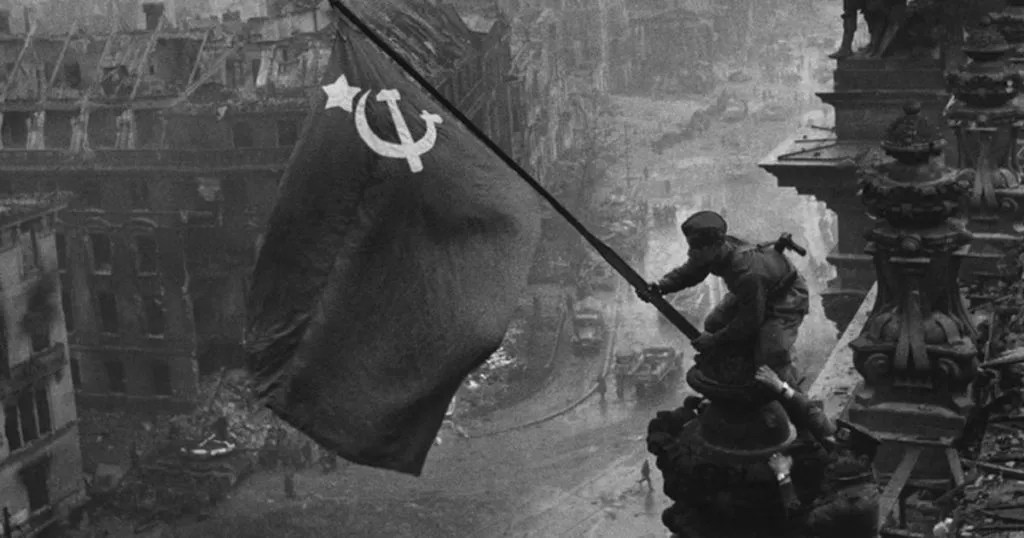
On May 9, 1945, Nazi Germany signed its surrender in Berlin, after having provoked the bloody war that lasted from 1939 to 1945. Eighty years have passed since the roar of arms of the armies contending in Europe during the Second World War ceased and the red flag with the hammer and sickle flew over the Reichstag (Parliament) in Berlin. Eighty years since humanity, represented in the heroic struggle of the Soviet Union and the allied coalition, dealt a mortal blow to the bloodiest and most reactionary regime that history had known: Nazi Germany.
Commemorating this historic victory is not a mere exercise in memory, but a political and ethical necessity, especially at times like the present, when the ghosts of the past are trying to return. Analyzing this victory objectively allows us to go beyond the superficial and often distorted narrative, to understand the deep forces, class contradictions and material interests that clashed in the Second World War, revealing its true meaning and the defeat of Nazi-fascism as a victory of working and oppressed humanity against the most brutal expression of capital in crisis.
The Second World War did not come out of nowhere, its roots were sunk in the contradictions inherent in the capitalist system in its imperialist phase, as analyzed by Lenin, Stalin and other Marxist theoreticians. The Great Depression of 1929 exacerbated inter-imperialist tensions, leading to a bitter struggle for markets, resources, and spheres of influence. In this context of structural crisis, the bourgeoisie of some countries, especially in Germany and Italy, resorted to fascism as an extreme form of open terrorist dictatorship of monopoly capital. Fascism was not simply a crazy ideology, as some call it; it was the response of big capital to the revolutionary threat of the organized labor movement and to the very existence of the Soviet Union, the first socialist state in history. Hitler’s National Socialism, with its racist delirium, its expansionist pan-Germanism, and rabid anti-communism, represented the culmination of this reactionary degeneration, seeking to annihilate the “inferior race” (Jews, Gypsies, Slavs) and crush any vestige of workers’ organization or dissident thought. Its manifest goal was world domination and the enslavement of vast territories and populations for the benefit of German capital.
In the face of this onslaught of barbarism, the Soviet Union emerged as the main bulwark of resistance. Since its birth, the USSR had faced the hostility of the capitalist powers, but the fascist aggression of 1941 placed it at the epicenter of the global struggle. The Great Patriotic War, as this period is known in the countries of the former USSR and progressive sectors, was a feat of epic proportions, a life-and-death struggle for the defense of the first experience of socialist construction. The Soviet people, under the leadership of the Communist Party, led by Stalin, mobilized all their forces and resources to repel the invader. Soviet industry, massively moved eastwards in the face of the enemy advance, showed an astonishing capacity for resilience and war production, surpassing German in many respects, despite the enormous initial territorial losses.
The Red Army, composed of millions of workers, peasants and intellectuals conscious of what they were defending, fought battles of unprecedented courage and ferocity. The defense of Leningrad, subjected to a siege of almost 900 days that cost the lives of more than a million civilians; the bitter and courageous battle of Stalingrad, which marked a strategic and moral turning point in the war, destroying a large part of the German army; the gigantic tank battle at Kursk; and the unstoppable final offensive that culminated in the capture of Berlin, are milestones that testify to the supreme sacrifice of the Soviet people. It was not just a military struggle; It was an all-out war in which the civilian population, the partisans (guerrillas) in the occupied territories, the women who took up the work in the factories and the countryside, all contributed decisively to the victory. It is estimated that the Soviet Union suffered more than 27 million casualties, both military and civilian, a figure that shows the magnitude of its contribution and the price paid for victory. Without Soviet sacrifice, the defeat of Nazism would have been unthinkable or would have required an infinitely greater cost to the rest of the world.
But the victory was the result of a combined effort. The anti-fascist coalition integrated capitalist powers such as the United Kingdom and the United States, despite their contradictions with the USSR and their own imperialist interests. The United Kingdom bravely resisted Nazi bombing during the Battle of Britain and contributed on fronts such as North Africa and the Atlantic. The United States, after the attack on Pearl Harbor, deployed immense industrial and military power that was crucial, especially on the Pacific front against Japan and in the Normandy landings, which opened a second front long desired by the USSR.
It is also essential to recognize the heroism of the resistance movements in the occupied countries. Communist partisans, socialists, democrats, and patriots fought clandestinely against the invader, sabotaged its operations, rescued victims of persecution, and kept the flame of hope alive. The resistance, more often than not led by the communists, played a vital role in weakening the enemy and preparing the ground for liberation. This dimension of popular struggle and resistance from below, often downplayed in official histories, is crucial to a full understanding of victory.
From a Marxist perspective, the anti-fascist alliance was a classic example of a united front, a tactical union of diverse and even contradictory forces in the face of a common enemy. While the USSR was fighting for the survival of its socialist system and the liberation of the peoples, the allied capitalist powers were also defending their own interests: to stop an aggressive imperialist competitor that threatened their possessions and trade routes. The tensions and differences in objectives between the USSR and its capitalist allies were palpable during the war and would become evident immediately afterwards, giving way to the so-called Cold War. However, at the crucial moment of the struggle against fascism, the need for unity prevailed.
The victory of 1945 had consequences of historic scope for the development of the 20th century. Fascism, as a state ideology, was discredited and defeated militarily. A period of decolonization began, as the European imperialist powers, weakened by the war, could no longer maintain their vast colonial empires in the face of the rise of national liberation movements, many of them inspired by the Soviet example and socialist ideas. The world political map changed radically with the formation of the socialist bloc in Eastern Europe and Asia, expanding the field of countries seeking to build alternatives to capitalism. The prestige of socialism and the international communist movement reached very high historical levels.
In addition, awareness of the magnitude of Nazi atrocities, in particular the Holocaust, created an impetus for the development of international humanitarian law and the creation of multilateral bodies such as the United Nations, aimed at preventing future wars and protecting human rights. While these institutions have often been limited and exploited by the interests of the great powers, their creation was, in part, a response to the need to establish safeguards against the barbarism that fascism represented.
Eighty years later, we cannot rest on the laurels of victory. The reactionary winds are blowing again. Capitalism in global crisis creates growing inequalities, social polarization and despair, a breeding ground for the resurgence of ultra-right ideologies, exclusionary nationalism, racism and xenophobia. The denial or minimization of the crimes of fascism, the attempts to equate communism with Nazism, and the glorification of fascist collaborators in some countries are red flags that demand our utmost attention and firm opposition.
Commemorating the 1945 Victory from a real and objective approach implies understanding that the struggle against fascism is part of the broader struggle against the capitalist system that engendered it. It implies recognizing that the working class and oppressed peoples were the driving force of the resistance and victory and that we must strive to salvage their emancipatory role. It reminds us of the importance of organization, unity of action and international solidarity to face the threats of the present. The struggle for historical memory is a political struggle; combating the unconsciousness and distortion of the past is essential to defend the rights and achievements of the present and to build a different future.
The victory over fascism showed humanity’s ability to overcome barbarism when united around a common goal. The immense sacrifice made by the Soviet Union and all those who fought against the Fascist Axis, imposes on us the responsibility of not allowing history to repeat itself. The struggle for a world without exploitation, oppression, racism and war, a world of peace, social justice and labor, remains the fundamental task of our time. It is the best way to honor those who gave their lives for freedom.
80 years of the Great Victory over fascism! Honor and eternal glory to the heroes of the Red Army, to the communists, partisans, to the resisters, to all workers and to the peoples who fought and gave their lives! for freedom! Fighting fascism in all its forms is an obligation for the present! For a world without imperialist wars, or capitalist oppression!
Categories: History, International, World History
 Hitler’s theory of Lebensraum (Living Space) and the Yankees’ Manifest Destiny
  The Communists and the Bolivarian process
  The Warsaw Uprising, August 1, 1944
  Jack Shulman: Testimony of an American Communist. Part One: Spain (1937-1939)
  The Red Phoenix