
Nadya H. / Red Phoenix correspondent, Maryland.
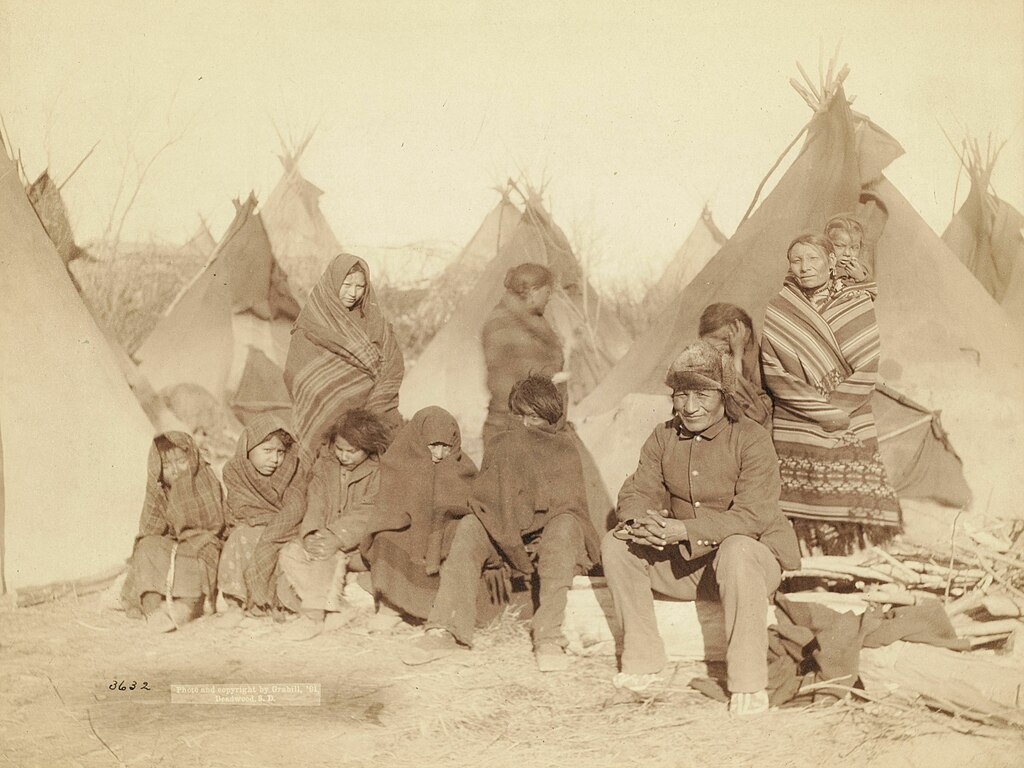
On December 29, 1890, over 250 Lakota men, women, and children were executed in what is known today as the Wounded Knee Massacre. Under pretenses of relocation, 500 soldiers of the 7th Cavalry Regiment of the United States Army, stoked by recent tension after the assassination of Sitting Bull and growing anti-Indian sentiment, opened fire on unarmed civilians with four Hotchkiss cannons and repeating rifles for several hours. The soldiers proceeded to go dwelling to dwelling, executing anyone upon discovery. Fleeing civilians were pursued and shot, some bodies found as far as three miles from the camp. In all, only four men and 47 women and children were left alive to be relocated.
The violence against the Standing Rock Reservation continues to this day, from police aggression against activists during the Dakota Access Pipeline protests to this particularly dark day in history. The series of events that triggered the Wounded Knee Massacre begins both with the forced relocation of the indigenous Sioux to reservations further west with the signing of the Sioux Treaty of 1868, and with the systematic mass slaughter and near-extinction of the American bison. As the United States continued to expand west, it had initiated a series of wars, massacres, and land appropriation against various native populations. One surefire strategy proposed by General Sherman was to target their largest food source: the bison. The buffalo represented a means of survival to countless Plains tribes who, without the buffalo, had little choice but to submit to the demands of the federal government and relocate to a reservation.
As with many reservations, conditions within the Standing Rock Reservation were abysmal. Drought heavily affected Sioux crops, rations were often reduced and late, and only those who lived on the reservation had access to food in a newly depleted ecosystem. In addition, in 1883 a set of laws were introduced, known as Indian Offenses, that made any traditional spiritual gathering illegal, intended to erase the identity of and forcibly assimilate the Sioux Nation. In the depths of squalor and desperate to hold onto their way of life, some Sioux embraced a new pan-tribal religious movement known as the Ghost Dance. The Ghost Dance originated from the spiritual visions of a Paiute man named Wovoka from Nevada, which synthesized Christian doctrine with traditional indigenous belief. This movement appealed to the Sioux as it promised a return to old ways and the restoration of their lands with bison. This movement, however, was perceived by the government as a potential cause for violence against the settlers and newly established gold mining industry in the Black Hills of Dakota.
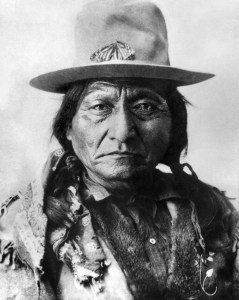
On December 15, 1890, tribal police from Standing Rock were sent to apprehend Sitting Bull, a renowned Sioux tribal leader who lived in a large camp on the reservation. Sitting Bull did not participate in the Ghost Dance himself, but it was rumored some members of the camp had at his instigation, prompting a response from uneasy settlers. As members of the camp rushed to help Sitting Bull, a shot was fired at a tribal officer, to which the officers responded by shooting Sitting Bull in the chest and head, killing him and seven members of his camp while police casualties numbered six.
Fearing a reprisal from the encounter, members of Sitting Bull’s camp sought refuge with Spotted Elk, his half-brother. Spotted Elk led the band south to the Pine Ridge Reservation in hopes of finding sanctuary under the protection of Chief Red Cloud. Flying a white flag and having contracted pneumonia, Spotted Elk’s group was intercepted by the 7th Cavalry and escorted to a camp near Wounded Knee Creek. That night, the 7th Cavalry positioned four Hotchkiss cannons around the camp.
The specific events of the massacre are clouded, but what is known is that the camp was ordered to surrender their firearms by the 7th Cavalry. A firsthand account from tribesman Dewey Beard Lakota states:
“…Most of the Indians had given up their arms; there were a few standing with their guns, but the soldiers had not been to them. The knives were piled up in the center of the council; some young men had their guns and knives, but they had not been asked yet for them. There was a deaf Indian named Black Coyote who did not want to give up his gun; he did not understand what they were giving up their arms for… The struggle for the gun was short, the muzzle pointed upward toward the east and the gun was discharged. In an instant a volley followed as one shot, and the people began falling….”
Those who were not killed in the immediate volley attempted to flee down a ravine, only to be hunted down by soldiers. Children were lured out of places of hiding and executed. Not even infants, nursing mothers, or the elderly were spared their gruesome fate, all were killed indiscriminately.
After the firing subsided, 250-300 Lakota, half of them women and children, lay slain. The dead were buried in a mass grave, with widespread looting taking place by soldiers. The United States awarded 20 Medals of Honor to soldiers who participated in the massacre, their deeds ranging from “gallantry” and “bravery” with the commanding officer receiving little more than paperwork for facilitating the murder of over 250 people.
To this day, the wound of the massacre has never been allowed to heal. Standing Rock was once again targeted in 1960 when five dams were built along the Missouri River by the US Army Corps of Engineers, flooding over 200,000 acres of the reservation’s land. Sacred grounds were destroyed overnight, graveyards, towns, and historic villages were flooded and lost forever. The reservation’s ecosystem and source of timber were largely wiped out when the dams were built, with little compensation paid to the inhabitants.

In 2016, the US Army Corps of Engineers once again dealt a blow to the Standing Rock Sioux Nation with the proposed $3.7 billion Dakota Access pipeline, which would cut across the Missouri river and contaminate their primary water source, in addition to the potential destruction of archaeological sites the construction would entail. Protestors of the pipeline were met with teargas and water cannons in the cold of winter, with over 300 attendees wounded by law enforcement. In 2017, Trump reversed the decision to halt construction, and the pipeline was eventually built. The American policy of “do what you want, apologize later” has enabled a history of violence to be perpetuated against our indigenous population since the founding of our country. Fascistic violence has a template in the treatment of Native Americans, and this violence still continues in its original form today. With revolutionary action and solidarity with our indigenous comrades, may we never see another Wounded Knee.
Categories: History, U.S. News, United States History
 Erasure of Black WWII heroes a blow to historical truth, working-class unity
  In memory of Chip Berlet (1949—2026), lifelong anti-fascist fighter
  Jesse Jackson: A man out of history returns home
  Indigenous resistance to ICE, a new front in an old war
  The Red Phoenix