
Allison P. / Red Phoenix international correspondent.
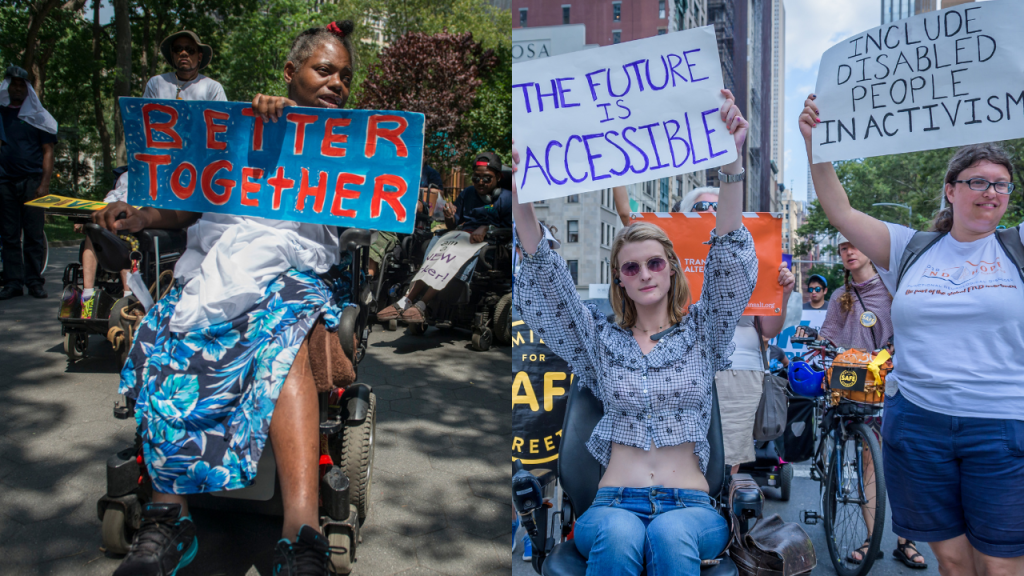
Each year on Dec. 3, the countless struggles and adverse conditions of disabled people are brought to light by observing World Disability Day. (Formally, the “United Nations’ International Day of Persons with Disabilities.”)
The disabled make up the largest and most diverse of any minority. It is also the only minority population which any person may join at any time, and should they be fortunate enough to live a long life, most people certainly will become disabled eventually. Despite this, the struggles of the disabled are often overlooked and forgotten. Disabled people are more likely to be unemployed, impoverished, homeless, imprisoned, and abused by the systems designed to protect us.
There are roughly 42.5 million people in the US who live with a disability. These can take many forms that vary in severity such as hearing and visual impairments, developmental disorders, physical disabilities including permanent injuries, mental illnesses, and more. Some conditions are primarily disabling due to the effects of the society we live in – falling under the “social model” of disability – while other conditions do have significant disabling effects even without societal barriers.
One thing all disabilities have in common is that they are made worse by the structures of capitalism. We live in a world which values productivity over quality of life. Some disabled people are able to be “productive” and function within capitalist society, however many struggle to survive. The employment rate among disabled people is only roughly 20% compared to 66% of non-disabled people. In addition, those who are employed are more likely to only work part-time. As a result disabled Americans that do work earn significantly less on average than their non-disabled counterparts, $28,438 median versus $40,948, a difference that is significantly larger than the income gap between men and women. However some 80% of disabled people are not employed, a number that can increase to up to 95% for certain populations such as those with schizophrenia.
The process to acquire disability benefits through Supplemental Security Income (SSI) – the federal Social Security program that provides income to those who are deemed unable to work, and who have not worked enough in the past to qualify for full Disability (SSDI) benefits – is a very long and difficult one that often requires multiple attempts over months or years before being “awarded” with a measly pittance of $914 a month, an income that is 20% below the national poverty line. The monthly SSI benefit amount for a disabled couple receiving is only $1371. In addition, SSI recipients are penalized if they have a partner who works (even if not legally married), resulting in reduced or eliminated benefits, and are beholden to strict asset limits that make it virtually impossible to save for important necessities like housing deposits, vehicles, and emergencies. Thus, disabled people still face marriage inequality today, especially people who are unable to work and dependent on SSI – a thinly veiled remnant of eugenics laws.
Disabled people are also frequently abused by the state and systems meant to protect them. For instance, disabled people are roughly three times as likely to be imprisoned, and there have been numerous cases of police killing disabled people. Despite making up only 13% of the population, people with disabilities comprise between one-third and one-half of all people murdered by the police. Even outside direct confrontation, many disabled people – particularly those with mental illnesses – are subject to an involuntary 72-hour psychiatric hold, in which police, without any training in mental health crises, come and take them away and lock them in a hospital. After the initial holding period, they may continue to be held or sent to longer term hospitals. Some people are fortunate enough to be cared for in an adequate and safe hospital, though that experience is very far from universal. Common experiences include being ignored by providers, injected with sedatives, and restrained. The rampant overuse of involuntary holds and the notorious poor treatment inside psychiatric facilities are so ubiquitous that patients have their own colloquial terms for them – getting “5150’ed” refers to being held involuntarily, and being “booty-juiced” refers to the forced sedation injections that are typically used as a form of punishment. These facilities operating within a for-profit healthcare system are only motivated to pacify or penalize their patients and make them “productive.” It is a cruel system which does not care for the people in need, instead leaving them scarred and traumatized.
The United States has made some significant strides in its disability protections and access. The Americans with Disabilities Act in particular helped to create better accessibility to many buildings with the inclusion of ramps and elevators. In this one singular aspect, it is among the best in the world. However many of the promises of the legislation have failed to come to fruition. The employment rate of disabled people has dropped from nearly 50% before the ADA to less than 20% now. Many disabled people report discrimination from would-be employers when disclosing their disabilities before being hired, which is unfortunately difficult to prove or to enforce due to labor policies such as at-will employment.
In light of these ongoing struggles, World Disability Day is observed to mobilize mass support while celebrating successes. Disabled people suffer disproportionately under the conditions of capitalism, and doubtlessly many more will be scarred or killed by this cruel system. Despite this, disabled people come together in solidarity, building their own vibrant communities to celebrate their lives and unique ways of living.
Categories: Discrimination, U.S. News
 Experts warn U.S. in early stages of transgender genocide, but truth may be worse
  Erasure of Black WWII heroes a blow to historical truth, working-class unity
  Indigenous resistance to ICE, a new front in an old war
  Democratic Party reinforces oppressive status quo
  The Red Phoenix