
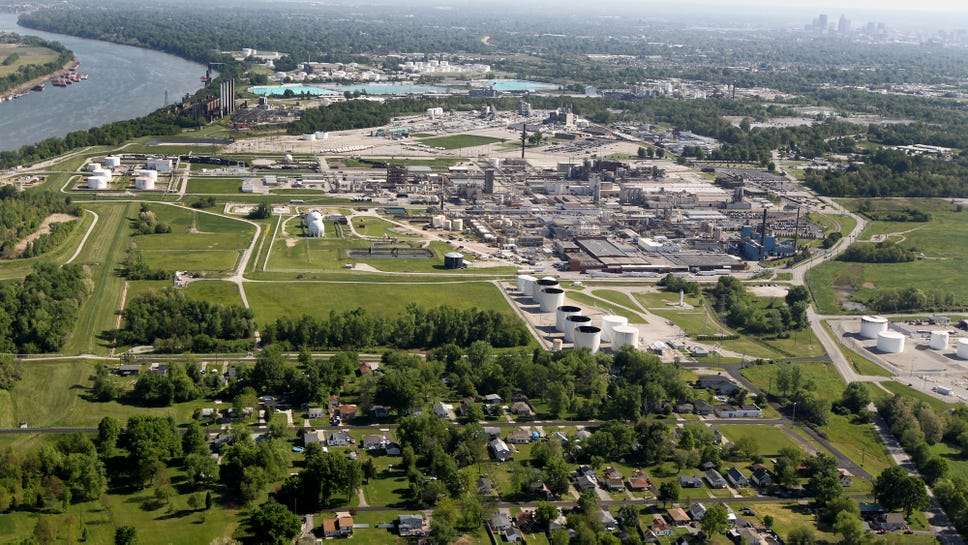
M. A. Booth / Kentucky.
For decades, “Rubbertown” in Louisville, Kentucky, has been a major source of concern for residents of the city. Despite the local government and corporations telling us that the level of Toxic Air Contaminants (TACs) in the area has dropped by 80% since 2005, the noxious odors can still be smelt from miles away. This problem is far bigger than any environmental regulation or reform can solve by itself. It’s a problem with the system of capitalism itself.
“Rubbertown” as we know it today came into existence during WWII with the establishment of many new industrial plants along the Ohio River on the west side of Louisville. The companies that moved into the area included Union Carbide, B.F. Goodrich, and DuPont. After the war, the area continued to be a hub for the manufacturing of synthetic rubbers, vinyl fluoride, plastics, and petroleum-based products of all types. This industrial development has provided jobs to hundreds if not thousands of workers over the years, but at what cost?
According to the West Jefferson Community Task Force (WJCTF), the industrial complex in “Rubbertown” accounts for 42% of all industrial air emissions in Jefferson County. Eleven companies are responsible for this mess. This includes American Synthetic Rubber Co., ATOFINA Chemicals Inc., Borden Chemical Inc, Carbide Industries LLC, E. I. du Pont de Nemours and Company, DuPont Dow Elastomers L.L.C., Noveon Inc, OxyVinyls LP, PolyOne, Rohm and Haas Co., Zeon Chemicals LP.
While the Strategic Toxic Air Reduction Program (STAR) has improved local air quality somewhat, it still hasn’t solved the problem once and for all. In recent years, the American Synthetic Rubber Company has been fined under STAR for emitting dangerously high levels of toxic chemicals known to cause heart disease, respiratory illnesses, and various forms of cancer in humans and other animals. What was their punishment for this egregious crime against humanity under capitalist law? A measly slap-on-the-wrist fine that amounts to pocket change for a company that’s worth millions upon millions of dollars. With weak legislation in place that benefits the owners of the corporations at the expense of regular working-class people, it’s no wonder the corporations haven’t changed their ways.
As is always the case in American capitalist society, marginalized workers — especially people of color and the poor — suffer the most. In “Rubbertown,” nearly 60 percent of the residents that live within three miles are people of color and more than 45 percent live below the poverty line. The inequality is truly staggering. Under capitalism, clean air and many other necessities such as food, water, shelter, and an overall healthy ecosystem, are not considered human rights, but commodities to be bought and sold on the market for their maximum exchange value.
Until the profit motive has been forcibly removed from our society as a whole through the dictatorship of the proletariat, we will continue to deal with the horrendous consequences of capitalist economic development. Socialism (the lower, developing stage of Communism) provides us a clear path out of the environmental and humanitarian crises we find ourselves in. Capitalism may try to temporarily “fix” itself with legislative reforms, but it cannot solve the underlying contradiction that gives rise to these problems: economic and social exploitation by and for the ruling class.
Categories: Environment, U.S. News
 Capitalist interests target climate research center in Colorado
  Northern Colorado reels from extreme gusts in record-breaking warm winter
  Price of climate change, Hurricane Melissa leaves Caribbean in ruins
  A.I. data centers cause rising electricity cost for consumers
  The Red Phoenix