
By Ed Rampell, Red Phoenix guest contributor, California.
(Note: This is the unedited text for the introduction to the April 23 screening of Objective, Burma! at the Academy Museum for this series commemorating the 75th anniversary of the Hollywood Blacklist.)
Who attended our screening of 1944’s None Shall Escape? Like today’s movie, Objective, Burma!, it’s a WWII morale booster co-written by Lester Cole, one of the Hollywood Ten. In his autobiography Hollywood Red, Cole writes that in the original story for None Shall Escape the Polish Jews were portrayed as too passive. But Cole, who was of Polish and Jewish descent, decided to depict them more militantly, resisting the Nazis. Cole admits that for the Rabbi’s rabblerousing speech he “plagiarized” a “line made famous by… La Passionara,” the Spanish Civil War’s fiery anti-fascist orator. That dialogue which Cole “stole” was: “Fight, fight, for freedom, for justice. It is far better to die on your feet than to live on your knees!”
During WWII Communist Party screenwriters and other independent leftists were drafted to write Hollywood’s anti-fascist films because they had the consciousness and conscience necessary for inspiring wartime audiences to support the war effort. Objective, Burma! doesn’t have much politically aware dialogue, although it does have something in common with Cole’s plot for None Shall Escape, which is framed through the prism of a Nuremberg-like tribunal condemning fascist crimes against humanity. As you’ll see, Objective, Burma! is also concerned with the issue of war crimes committed by the Axis powers.
Objective, Burma’s! original story was written by Alvah Bessie, who like Cole, became one of the Hollywood Ten. Bessie received one of the movie’s three Oscar nominations, for Best Writing, Original Story. He had volunteered to fight fascism in Spain as a member of the Abraham Lincoln Brigade and wrote a highly regarded account of the Spanish Civil War, Men in Battle. Cut short by the Blacklist, Alvah’s screenwriting career lasted only about five years. But Bessie put his so-called “premature anti-fascism” to good use in Tinseltown. In addition to Objective, Burma!, he also co-wrote 1945’s Hotel Berlin and 1943’s Northern Pursuit, which like today’s movie starred Errol Flynn.
As moviedom’s greatest swashbuckler, from portraying mutineer Fletcher Christian in 1933’s In the Wake of the Bounty to playing rebel pirates in 1935’s Captain Blood and 1940’s The Sea Hawk, and but of course depicting the title character in the 1938 classic The Adventures of Robin Hood, Errol Flynn epitomized the democratic hero fighting screen tyrants. But little is known about Flynn’s role regarding the Left.
A book alleges Flynn was secretly a Nazi spy, but according to his autobiography, Errol’s sympathies were with the Left. Was Captain Blood a Red? I don’t know how true this is, because in all of my research on the Hollywood Left, the Australian actor was never mentioned as being a member of any particular left-wing organization or supporter of leftist causes. I think Flynn was more interested in partying with John Barrymore and W.C. Fields than in the Party. But according to My Wicked, Wicked Ways, the Tasmania-born Flynn claims that when he was a white overseer at a plantation for forced labor in what is now Papua New Guinea, Flynn passed his time reading books about Marxism, even as he was part of the system exploiting the toil of Melanesians.
In 1937 Flynn went to Europe to cover the Spanish Civil War for the Hearst Press. Here’s a brief account: In Paris, “On March 21 Flynn attended a memorial service for the Clichy victims, who had died during a March 16 demonstration when the police fired into the crowd, killing six and wounding 200.” Flynn continued on to Spain via train and wrote that at “Barcelona … I have to give short speech and am cheered when I finished with clenched fist communist salute and the word ‘Salute’ … Great reception!” The movie star also autographed publicity pictures provided by Warner Brothers and visited the International Brigades.
At a lunch with high-ranking military officers, one talked about “the heartfelt emotions and happiness the Spanish people felt that their hero of the screen and upholder of justice, Errol Flynn, was with them. The Spanish people would never forget this… I sat there in amazement, trying not to show surprise to be cast in such a role,” the self-deprecating Flynn wrote.
At night Flynn went to Madrid’s University City where heavy fighting was reported. He found himself suddenly caught in the middle of it and had to take shelter. An artillery round fell nearby, causing the bombed-out building to shake and a large chunk of plaster fell on Flynn’s head, knocking him out.
As I recall, in My Wicked, Wicked Ways Flynn wrote he visited the front lines where, cheering him on, Loyalist soldiers gave him a rifle – but the star of Captain Blood didn’t have the stomach to shoot real life fascists.
Towards the end of his life, Flynn made two left-wing films, directing the documentary The Truth About Fidel Castro Revolution. In 1959’s pro-Castro Cuban Rebel Girls Flynn played an American correspondent. Interestingly, Henry Hull plays an over-the-hill correspondent in Objective, Burma! Unfortunately, the movie uses objectionable racist slurs for the Japanese. To be fair to Lester Cole, his 1945 Blood on the Sun, which stars Jimmy Cagney, depicts anti-fascist Japanese characters. And in Objective, Burma! there are some sympathetic Chinese and Burmese minor characters, plus Asit Koomar as the Gurkha soldier.
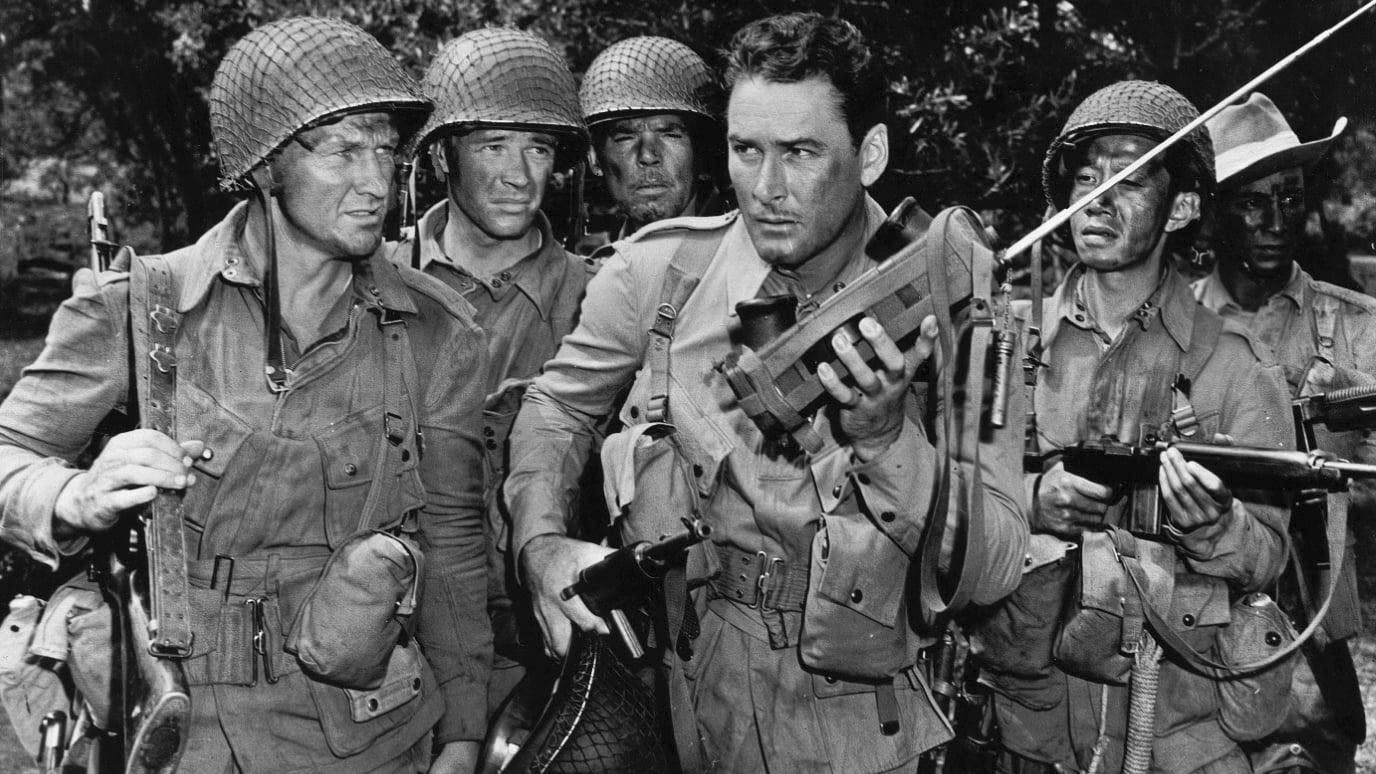
Now, making the world safe for democracy in the deepest darkest jungles of the L.A. Arboretum and Botanic Garden is director Raoul Walsh’s action-packed Objective, Burma!
This article is one installment of our Hollywood Blacklist series by film historian and critic Ed Rampell. The complete series can be found below:
- It can happen here: Three L.A. museums shine spotlights on the Hollywood Blacklist’s 75th anniversary
- Hollywood Blacklist: “Tender Comrade” and “Sahara”
- Hollywood Blacklist: “Cloak and Dagger” and “None Shall Escape”
- Hollywood Blacklist: The Duke, draft-dodging opportunist
- Hollywood Blacklist: “Objective, Burma!”
- Hollywood Blacklist: “Spartacus”
- Hollywood Blacklist: “Salt of the Earth” and a demand for political reckoning
For details about the Hollywood Ten at 75 film series in Los Angeles, visit the Academy Museum website.
Ed Rampell was named after legendary CBS broadcaster Edward R. Murrow because of his TV exposes of Senator Joe McCarthy. Rampell majored in Cinema at Manhattan’s Hunter College and is an L.A.-based film historian/critic who co-organized the 2017 70th anniversary Blacklist remembrance at the Writers Guild theater in Beverly Hills and was a moderator at 2019’s “Blacklist Exiles in Mexico” filmfest and conference at the San Francisco Art Institute. Rampell is presenting “The Hollywood Ten at 75” film series at the Academy Museum of Motion Pictures and is the author of Progressive Hollywood, A People’s Film History of the United States and co-author of The Hawaii Movie and Television Book.
Categories: Media & Culture, Movies
 ‘One Battle After Another’: Fun yet limited bourgeois depiction of revolutionary struggle
  The “Molly Maguires,” America’s first great class war
  After 35 years, “Paris Is Burning” remains essential class-conscious queer cinema
  Film review: “Glory” and the art of liberation
  The Red Phoenix